

Love x Learning x Play: The Equation for a Meaningful Life
A meaningful life emerges when love, learning, and play work together to create daily flourishing.
Author
Founder of the Universal Enlightenment & Flourishing Foundation and a past Fellow and Impact Leader in Residence at the Harvard Advanced Leadership Initiative. Author of Bridges Across Humanity and Love Learn Play.
70 articles

A meaningful life emerges when love, learning, and play work together to create daily flourishing.

You can grow your entire life and still feel empty. The flourishing mindset adds what growth mindset lacks: love, play, purpose, and wholeness.

King Midas turned his daughter to gold chasing wealth. The Means-Ends Inversion explains why modern achievers make the same mistake.

Iris Mauss proved it: the more you chase happiness, the lonelier you feel. The solution is not better pursuit but a different goal entirely -- flourishing.

We have become experts in the parts but forgotten how to see the whole. Flourishing requires breaking the false dichotomies between science, spirit, and self.
Akhil Gupta's personal reading list: 20+ history books that reveal why civilizations rise, fall, and repeat the same mistakes.

A gardener's experiment proves it: what you speak to yourself shapes what grows. Practical affirmations for morning, midday, and evening.

Arjuna's fears on the battlefield mirror modern anxieties about duty and purpose. The Bhagavad Gita's answers remain startlingly relevant.

"Who am I?" Indian philosophy says the answer is not your name or role. Vedanta and the Upanishads reveal: you are already what you seek.

Spiritual health is not optional wellness. Seven practical habits -- from structured reflection to mindfulness -- build lasting inner clarity and resilience.

Soul ties are deep emotional bonds that transcend logic and distance. Learn what they are, their types, and how to break free from unhealthy ones.

Self-worth shapes lasting joy — not through achievement, but through self-compassion, inner awareness, and unconditional self-acceptance.

Ananda is not happiness from possessions. Hindu philosophy says bliss is your true nature, obscured by attachment. Here is how to access it today.

Emotional safety is the ability to be fully yourself without fear. Here is how to recognize it, build it, and why science says it matters most.

"Love thy neighbor" is a communal mandate, not personal virtue. Christian scripture and modern research agree: active service builds community.

You can grow spiritually without religion. Mindfulness, service, and self-awareness offer paths to meaning beyond traditional faith.

Chasing happiness ties joy to future milestones. Being happy means choosing contentment now. Psychology and ancient wisdom agree on which works.

Your body keeps score during spiritual awakening. Here are 10 physical symptoms -- from crown tingling to unexplained fatigue -- and what each one signals.

Waking up to false narratives is not enough. Part 3 of the LLP series tackles the harder step: living consciously in every moment, every decision.

Water, fire, flying, falling -- dream symbols carry spiritual weight across every major faith. Learn what your recurring dreams may signal.

Rumi wrote about love as a path to the divine, not just romance. 50+ quotes organized by theme -- from self-love to surrender to healing.

34 books on religion and spirituality -- from Huston Smith to Einstein -- chosen to reveal why faiths divide on the surface but unite at the root.

King Midas destroyed what he loved chasing gold. False narratives about success do the same to us. Part 2 of the LLP series names the barriers.

Children flourish through love, learning, and play. Adults forget how. Part 1 of the LLP series explains why income doubled but happiness did not.

60+ growth mindset quotes from Einstein to Mandela -- including a "savage" section for when you need blunt motivation, not gentle encouragement.

50+ kindness quotes from Mark Twain to Rumi -- organized for kids, adults, and the workplace. Compassion is strength, not softness.

You cannot pour from an empty cup. 30+ self-care quotes across mindfulness, mental health, and daily life to remind you rest is productive.

30+ positive quotes sorted by context -- work, women, motivation -- each chosen to shift your thinking in one sentence.

201 handpicked morning quotes -- from Paulo Coelho to the Dalai Lama -- organized so you can find the right spark for any mood.

Gratitude is not the result of happiness; it is the cause. 100 quotes from Rumi to Maya Angelou, organized to build a daily thankfulness practice.

Mindfulness is a way of being; meditation is a way of training. You can practice one without the other, but together they compound.

Ikigai is the Japanese art of finding your reason to wake up. It sits at the intersection of passion, skill, need, and livelihood.

Over 100 curated quotes from the Dalai Lama, Buddha, Rumi, and more -- organized by mood to shift your mindset in under a minute.

The Bible names four types of love. Agape -- unconditional, divine love -- is the highest. Finding lasting love means cultivating it, not just finding it.

Inner peace is not escape from challenges; it is mastering the calm within. Neuroscience confirms what ancient traditions teach: mindfulness rewires the brain.

Seven timeless rules -- from letting go to radical self-honesty -- backed by the Bhagavad Gita and modern psychology. A daily framework.

Detachment is not emotional numbness. The Bhagavad Gita, Buddhism, and Stoicism agree: freedom comes from releasing your grip on outcomes.

Spirituality without social justice is incomplete. Flourishing requires both inner peace and outward action -- love, service, and ethical living in balance.

The Golden Rule appears in every major faith. Humanism takes these shared ethical principles and makes them accessible to believers and non-believers alike.

Psychology and spirituality converge: flourishing requires balancing dualities, practicing rituals, and centering on love. Science confirms it.

Three pervasive myths -- materialism, constant joy, and radical individualism -- keep happiness out of reach. Religious philosophy exposes each one.

Compassion, truth, justice, forgiveness -- every major religion teaches the same core values with different words. The parallels are systematic.

Flourishing is not happiness. It is holistic well-being -- emotional, spiritual, social -- built on purpose, karma, and ethical living across traditions.

Psychologists and religious traditions agree: after a basic threshold, more possessions mean more anxiety, not more happiness. Here is what works instead.

Modern life delivers comfort but strips away meaning. The missing dimensions of happiness are love, community, purpose, and karma -- not more possessions.

What if God can only be described by what God is not? Apophatic theology -- from Hindu "neti neti" to Jewish "Ein Sof" -- reveals why language fails.

Every religion diagnoses the same problem: humans are limited, biased, and prone to suffering. Each offers a different escape route from the same trap.

Hinduism says "neti neti." Judaism says "Ein Sof." Every faith agrees: ultimate reality exceeds human language. Here is what that means for seekers.

Job meets God in the whirlwind. Jesus calms the storm. Krishna reveals cosmic fire. Three traditions, one pattern -- discovered without even searching for it.

Moksha, nirvana, paradise, the Tao -- every religion maps a path from mortal limitation to divine transcendence. The methods differ; the destination converges.

Christianity, Hinduism, Islam, and Buddhism all treat the body as a sacred vessel. The chariot metaphor from the Katha Upanishad appears in every tradition.

God speaks from the whirlwind. Jesus calms the storm. Krishna reveals cosmic fire. Three traditions, one pattern: the divine overwhelms before it transforms.

Christianity calls family the "domestic church." Every major tradition agrees: the family unit is where spiritual education begins and beliefs take root.
Helen Keller overcame blindness and deafness. Every religion says we all face comparable limitations -- spiritual, cognitive, perceptual.

Faiths that preach oneness produce the deepest splits. Christianity has 40,000 denominations. The irony of religious division, mapped across every tradition.
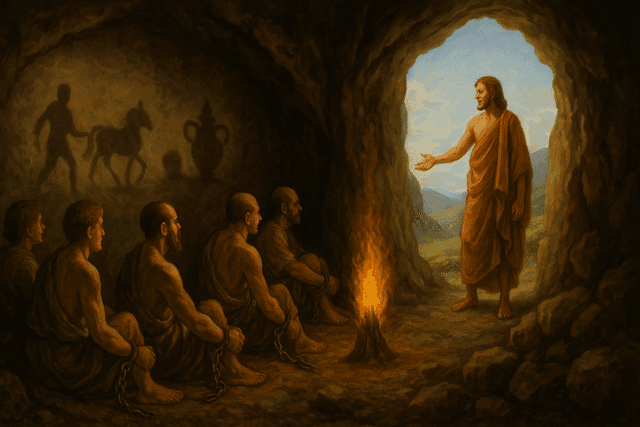
Plato's prisoners mistake shadows for reality. Hinduism calls the same illusion Maya. Every tradition maps the same escape: from ignorance to enlightenment.

Forgiveness frees the one who forgives. Repentance destroys the ego. Every major faith prescribes both as the path to self-liberation.

Forgiveness liberates the forgiver, not just the forgiven. Gandhi, the Jain Samvatsari ritual, and every major scripture agree: it is strength, not weakness.

Samsara, Yin-Yang, Whirling Dervishes, resurrection -- circular time appears in every tradition. The cycle is not a trap but a path toward liberation.

Family is where we first learn to love. Across religions -- from Confucius to the Baha'i faith -- family unity is the prerequisite for community.

Noah, Gilgamesh, Matsya, Deucalion -- flood stories appear in nearly every culture with identical elements. Coincidence or shared memory?

Jesus and Krishna never met, yet their ethical teachings converge on duty, selfless action, and inner transformation. The parallels are striking.

From Abraham's test to Buddhist detachment, sacrifice means surrendering ego, not just making offerings. Every tradition agrees on this evolution.

Eight major religions, one message: oneness. Scriptural quotes from each tradition prove the ethical foundation is shared, not separate.

Cain and Abel. The Mahabharata. Romulus and Remus. Sibling rivalry is humanity's oldest moral lesson -- about envy, responsibility, and reconciliation.

Happiness. Fulfillment. Plenitude. We often long for a state of consciousness we can label to denote ‘life satisfaction’. At UEF, our intention is, rather, to..

Happiness. Fulfillment. Plenitude. We often long for a state of consciousness we can label to denote ‘life satisfaction’. At UEF, our intention is, rather, to..

Love To love is to have deep-seated compassion for others. The highest forms of love would have us give ourselves entirely without an expectation of..

An important aspect of the LLP mindset is that it acts as if it is radiating outwards from ourselves. This is perhaps the easiest to..

Happiness. Fulfillment. Plenitude. We often long for a state of consciousness we can label to denote ‘life satisfaction’. At UEF, our intention is, rather, to..