


Introduction
Indian philosophy has long understood spirituality not as a set of rituals but as an inward journey of self-discovery. Vedanta, one of the most influential schools of Indian thought, explores the nature of consciousness, the self and ultimate reality through texts including the Upanishads and the Bhagavad Gita. At its heart, what is spirituality according to Indian philosophy comes down to one central question: Who am I? This blog explores what Vedanta and the Upanishads teach about that question and how their insights apply to life today.
Vedanta is a school of Indian philosophy that explores the nature of consciousness, the self, and ultimate reality.
What Is Spirituality in Hinduism? The Indian Philosophy Answer
In Hindu spirituality, the journey begins by looking within and asking the central question, “Who am I?”
Today, if someone were to ask us this question, we would simply respond by telling them our names. But Indian philosophy and spirituality challenge this very belief.
Think for a moment: are we just a collection of letters? If asked again, then our next most normal response to the same question would be, we are someone’s wife, husband, son, daughter, or mother," or add a fancy professional tag to our reply. Indian philosophy and spirituality further critique this myth.
So who are we? An intriguing question worth pondering upon.
Another response to this question can be, "I am a body that I see in a mirror.
But are we really this? If we see an object in the universe, do we become the object? If one sees a beautiful red Lamborghini, do they believe that they are that object? The response would be “No. How can we be the object that I am looking at?”
If we cannot be any object outside in the world. So, how can we be the body or person we see in the mirror?
We are the ones who are inside the body, looking at the world. This may take time to sink in as it challenges our very beliefs and shakes the very foundation of our understanding of ourselves.
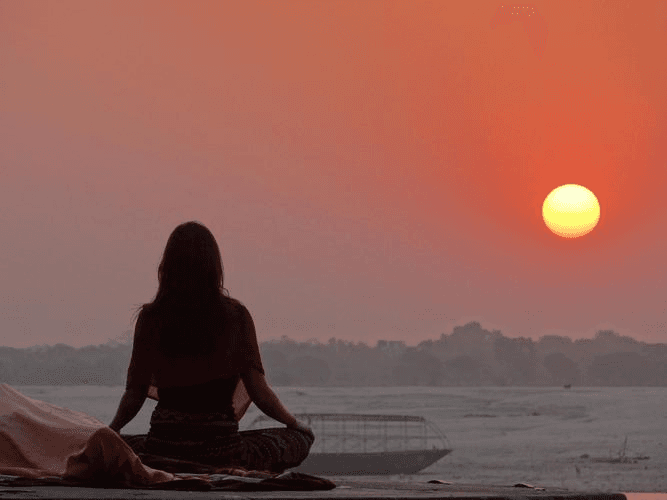
When we contemplate the very nature of self, in silence, we are meditating. In Indian philosophy, meditation is given the utmost importance. With time, through the help of meditation, the endless thoughts that occupy our mind begin to drift away, and our consciousness increases. This is when we begin our odyssey to return to the root of our inner being, a stage of simple awareness or being aware, beyond the body and mind.
Only then do we get pure consciousness that:
We are the ones who see, occupying the centre seat of self, we look out and are aware of the events, thoughts, and emotions that pass by us. We are the eternal, divine energy.
In the Hindu philosophy, especially the Upanishads, this divine energy is referred to as Atman.
- In the teaching Tat Tvam Asi, or “Thou art That.” The Tat Tvam Asi meaning is that the deepest self, Atman, is not separate from Brahman, the ultimate reality.
- The Katha Upanishad describes Atman as unborn, eternal and untouched by the death of the body. This teaching directs attention beyond the changing body and mind towards the enduring self.
We are the sun, not the sunlight; the ocean, not the waves; the fire, not the flame; the soul, not merely the body.
We can reach the stage of consciousness, where we are aware of who we are, only by going inwards and not identifying or attaching ourselves to outside objects.
Enjoying this article?
Get UEF Insights. Writing on loving, learning, and playing, with insights from wisdom traditions and modern science delivered to your inbox.
Vedanta and the Upanishads: The Indian Lens on Spirituality
Have you ever noticed the difference between a person who is consciously aware and a person who is not conscious? The answer is simple, the lack of awareness. The difference is that when our consciousness is not centered within, it becomes focused on external objects. That is when we look outwards for happiness and get easily agitated when things don’t go as planned. Whereas people who have a higher level of consciousness are centered and remain calm in the most challenging situations.
As per the Indian Vedanta and Upanishas, spirituality is not about following ritualistic practices, but is about realising your oneness with the inner self (Atman). It is an inner journey of self-discovery, where we realise that the soul (Atman) is beyond our mind, thoughts, body, and our bodily senses (pleasures); it is eternal, limitless, and unchanging. And this path of self-discovery reveals that the individual self (Atman) is one with the ultimate reality (Brahman).
The Indian lens on spirituality nowhere emphasises that one needs to renounce the world, to transform oneself, or to achieve this state. It can be achieved by living in harmony, while carrying out our daily duties (dharma), while remaining inwardly free, compassionate, and consciously aware.
What Do the Upanishads Teach? Core Concepts From Vedic Wisdom
What are the Upanishads? They are a collection of ancient Sanskrit texts that form the philosophical foundation of Hinduism, exploring the nature of reality, consciousness, and the self. The Upanishads' meaning is commonly understood as referring to sitting near a teacher to receive spiritual knowledge.
Spirituality, as per the Upanishadic wisdom, is the understanding of Brahman (the ultimate reality) and Atman (the individual self) and their interconnectedness.
All the Upanishads and Vedanta’s key teachings emphasize that spirituality is woven into every aspect of our lives. And our ultimate goal or purpose of our life is to recognize the unity of Atman with Brahman (the universal reality).
Here is a translated verse from the Mundaka Upanishad, which states:
“All that is in the front is Brahman, the immortal. Brahman is at the back, as also on the right and the left. It is extended above and below, too. This world is nothing but Brahman, the highest.”
The Bhagavad Gita and Vedanta have listed four primary paths of yoga, each attached with spiritual discipline tailored to natural human dispositions or tendencies, with the ultimate aim of Moksha: liberation from ignorance and suffering.
- Jnana Yoga: Knowledge and inquiry. This path uses study, reflection, and self-questioning to examine the nature of reality. Its central question is whether the self is truly separate from Brahman.
- Bhakti Yoga: Devotion and surrender. This path develops a loving relationship with the divine through prayer, remembrance, and worship. Devotion helps loosen the ego’s desire for control.
- Karma Yoga: Selfless action. This means performing one’s duties without being attached to recognition or reward. Everyday work can become a spiritual practice when it is guided by service.
- Raja Yoga: Meditation and discipline. This path trains the mind through meditation, concentration, and ethical discipline. Its practices help the individual move towards greater awareness.
Atman and Brahman: Vedanta and the Realization of Non-Duality
The non-duality meaning in Advaita Vedanta is that Atman and Brahman are not ultimately separate. “Ayam Atma Brahma," a quote from the Mandukya Upanishad, teaches us that the highest truth in our spiritual journey is the realization that our higher inner self (Atman) is not separate from the ultimate reality (Brahman). Brahman is the source of all that exists. Not a personal God, but a formless and all-pervading consciousness. And the path of realization, followed by the oneness of Atman and Brahman, leads to Moksha (liberation from ignorance, suffering, and the cycle of birth and death), our ultimate goal of life.
In Hindu philosophy, Maya refers to the illusion or veil of ignorance that prevents us from recognizing our true nature as Atman.
Adi Shankaracharya, the great Advaita Vedanta philosopher, emphasized that we are lost in the world of Maya (illusion or ignorance). He questioned the practice of asking, “Who am I?”
He further elaborated on the reasons behind our detachment from our inner selves. He explained that wearing these mystical glasses of Maya – illusion, we forget that each of us has a limited time on earth but go about living our lives, accumulating things of comfort as though we are going to be here forever. In turn, the illusory world of Maya steals us from realising our main purpose of life, i.e., identifying our true self, Atman, and its relationship with Brahman.
Love • Learn • Play
The formula for a meaningful life.
Only when we choose to remove these glasses, go beyond the ritualistic practices and seek the path of Jnana (knowledge), raise our consciousness, and realise our oneness with God, the unity of Atman and Brahman.
One of Shankara’s most famous lines (from Vivekachudamani):
“Brahman is real; the world is illusory. The individual Self is not different from Brahman.” (Brahma satyam jagan mithya, jivo brahmaiva naparah)
Spirituality Self-Realization Meaning: The True Goal of Indian Spirituality
In all scriptures, the human form of birth is considered the most superior form of living form not because of its intellectual or emotional power, but because of its ability to raise its consciousness, realize its oneness of the inner self (Atman), and fulfill life’s ultimate purpose: liberation (Moksha) from the cycle of life and death. It is said that even devas and deities yearn for the human form, for it alone offers the possibility of realizing the union of Ātman with Brahman.
Why Is India So Spiritual? A Land of Ancient Wisdom
India has always been seen as a land of mysticism and spiritual paradise. It is the birthplace of many religions of the world – Hinduism, Sikhism, Buddhism, and Jainism. This diversity reflects India’s deep-rooted religious pluralism, where different faiths coexist. It is a pious and spiritual land, a world in itself, where many enlightened souls have walked. These divine souls are highly revered and worshipped and looked upon as our spiritual teachers (Gurus), giving us our path to spiritual guidance and knowledge. They not only rescued people from suffering, but also preached higher ways of life. Their teachings were later captured in the Upanishads, the Granths, and other holy scriptures. They may not be in physical form, but their aura and presence are still felt in many sacred spaces and attract pilgrims in great numbers on special occasions.
We, even from different faiths, celebrate each of these festive occasions with a lot of fervor, not privately, but as a community, a shared experience, reinforcing values and spiritual beliefs and reminding us of the divine presence in our daily lives.
The Indian cultural core teachings of Dharma (righteous duties), Karma (a belief that our actions affect our future), Samsara (re-birth), and Ahimsa (non-violence) are the guiding principles and spiritual concepts that have been woven into the very fabric of our daily lives, families, and communities, reminding us of our collective identity.
India’s spiritual heritage also speaks to people beyond the traditions that began there. Questions about identity, duty, suffering and freedom belong to people everywhere. UEF brings wisdom traditions into conversation so that their differences can be respected while their insights contribute to a shared understanding of human flourishing.
Can Ancient Wisdom Help Us Today?
The Vedantic path of self-realization aligns naturally with UEF's understanding of human flourishing. The journey inward is not separate from how we love, learn, and play in the world. It is its very foundation.
If you have been reading this far, this thought may have passed through your mind. Do the ancient teachings or the wisdom of Indian philosophy: Vedanta, the Bhagavad Gita and the Upanishads still apply to the modern world? Would they help us today?
Well, it is more relevant than ever. These teachings may seem ancient; however, they are light-years ahead. They address our timeless inner struggles of fear, anxiety, stress, desires, search for meaning, etc. While the outside world may advance technologically, these struggles will continue to remain unchanged.
The scriptures clearly lay out that the path of attaining true eternal happiness is by ceasing to look outwards (external possessions) and going inwards. Realise that we are more than our body, mind, thoughts or experiences. We need to attain the consciousness that we are an Atman and our true purpose is to merge with the Brahman.
UEF’s broader work invites readers to explore sacred texts and different approaches to spiritual life with openness and care. Its Love, Learn and Play framework connects inward awareness with the relationships, discoveries and moments of joy that support a flourishing life. Spirituality can then become part of how we live, rather than something continually postponed.