
Mythical
What Does Fire Symbolize? The Spiritual and Religious Meaning of Fire

Fire As A Symbol
Fire can represent purification, transformation, destruction, rebirth, and the divine. The symbolic meaning of fire appears in many cultures and religious traditions. A flame can give us light and warmth, but it can also consume everything around it. This contrast explains the fire symbol's meaning and its lasting symbolic power.
People often search for or get drawn to the fire symbol because something about fire feels deeply familiar. Across different spiritual, cultural, and religious traditions, fire has been like a mirror of human experiences. It personifies our emotions, our struggles, and our longing for meaning. The symbolism of fire reflects both the chaos and clarity within us. Fire as a symbol carries layers of meaning. It can warm or destroy, illuminate or consume, and purify or transform. The duality is exactly why the fire symbol has continued to intrigue seekers across time.
What Does Fire Symbolize?
At its very core, when people What does fire symbolize? They are really talking about life itself. Fire represents purification, passion, destruction, rebirth, divine presence, and transformation. The flame symbol meaning often represents burning away the old and making space for the new.
Bahá’u’lláh’s words highlight the destructive power of speech, while Judaism’s story of the burning bush portrays fire’s non-destructive nature.
Fire symbolism is sacred to Hinduism, central to rituals like Homa, and symbolizing purity. Christianity employs fire as a symbol of the Holy Spirit, purification, and renewal. In Islam, the Quran mentions fire, representing punishment and purification, while Sufis use symbolic fire in ceremonies.
Judaism’s eternal flame symbolizes God’s presence, akin to the burning bush Moses encountered. Zoroastrianism reveres fire as pure and divine, present in sacred fire temples. Native American beliefs connect fire with the sun, healing, and spiritual connections.
Buddhism views fire as inner transformation. The inner fire is a symbol of awareness. It denotes the burning away of ignorance to reveal clarity and enlightenment. It is not external but deeply personal.
African religions see fire as a vital life force, purifier, and means of ancestor communication. Fire’s significance is woven into diverse faiths, embodying purification, transformation, and communion with the divine.
Enjoying this article?
Get UEF Insights. Writing on loving, learning, and playing, with insights from wisdom traditions and modern science delivered to your inbox.
The Meaning of Fire in Religion: Sacred Texts and Traditions
The meaning of fire in religion is different in sacred texts, rituals, and communities. In some traditions, religious fire is seen as symbolizing purification or the divine presence. It could also be associated with divine offerings or contact with the spiritual world. This flame symbolism is a recurring theme and shows how fire can have different meanings across faiths.
There are different interpretations of fire, but the symbolism often represents the human desire for purification, guidance, renewal, and relationship with the divine. This same symbolism offers one way to understand what all religions have in common beneath their distinct beliefs and practices.
Across sacred texts, fire has been used as a powerful metaphor to convey spiritual truths. It reveals the unseen forces that shape human consciousness.
“For the tongue is a smoldering fire… the fire of the tongue devoureth both heart and soul.” – Bahá’u’lláh
“Though the bush was on fire, it did not burn up.” – The Hebrew Bible (Exodus 3:1–2)
These passages go on to show how symbolic fire can represent both destruction and divinity. It can consume recklessly, like uncontrolled speech, or exist in a sacred presence that illuminates your path. This is why the fire symbol endures. It reflects something we already know about ourselves.
Hinduism: In Hindu traditions, fire represents sacred offering and surrender. Through rituals like yajna, symbolic fire becomes a medium between humans and the divine, and God Agni embodies this connection. Traditional practices and religious wear reflect this reverence.
Christianity: In Christianity, fire symbolism is used to depict the Holy Spirit, representing divine presence, purification, and transformation.
The burning bush encountered by Moses and the tongues of fire that descended upon the apostles at Pentecost are among the most significant fire symbols in the Christian tradition.
Islam: Fire is mentioned in the Quran, the holy book of Islam, and the symbolism of fire is often associated with punishment in the afterlife for those who are disobedient to Allah.
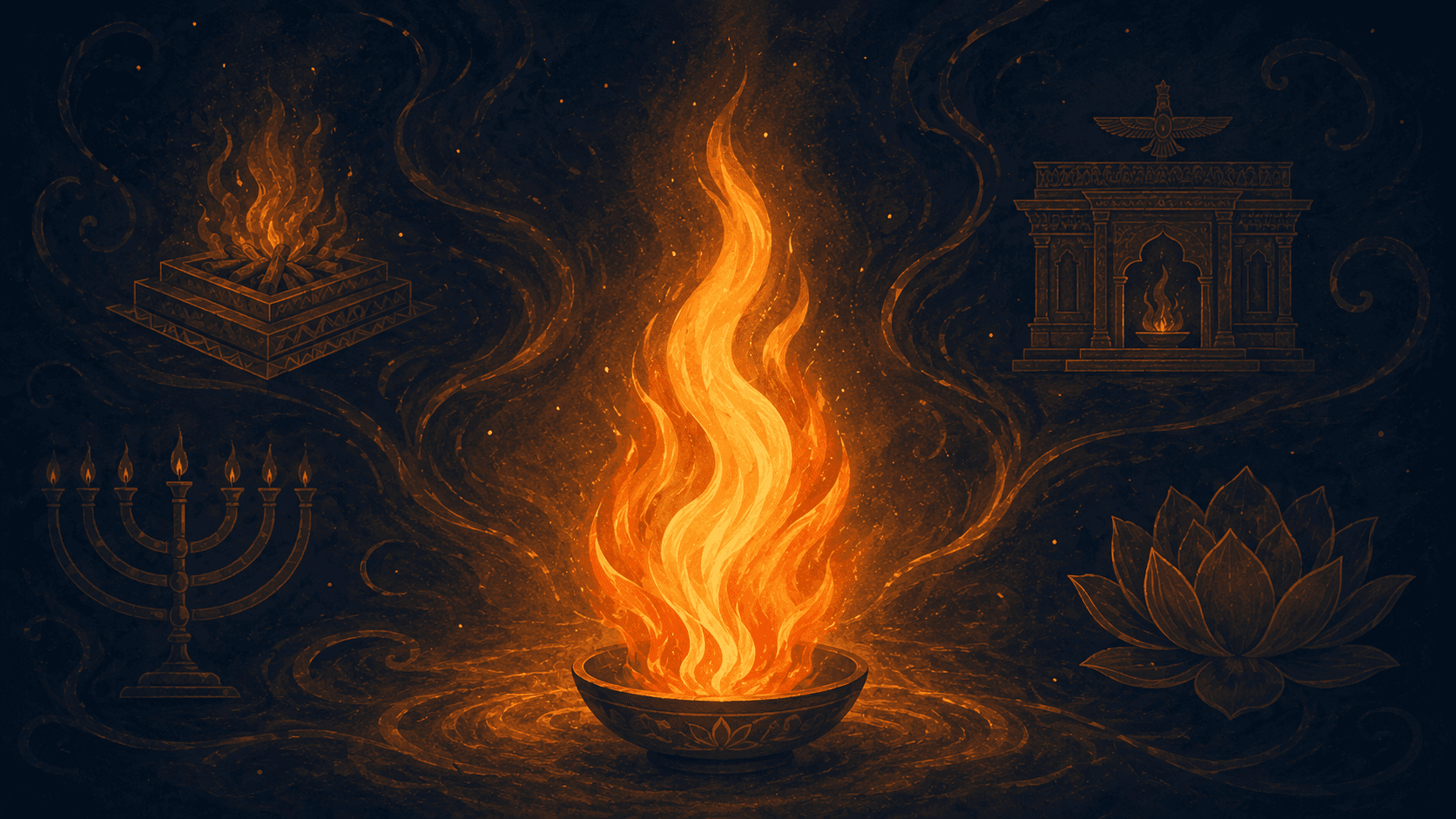
Judaism: In Judaism, the eternal flame, which is lit and kept burning in synagogues, symbolizes the divine presence of God and serves as a reminder of the burning bush that Moses encountered. Fire is also used in Jewish rituals, such as the lighting of the Sabbath candles and the Hanukkah menorah.
Zoroastrianism: fire symbol is considered one of the most sacred elements in Zoroastrianism, an ancient Persian religion. Zoroastrians believe in the fire worship as a symbol of purity and divinity. Fire temples, known as “Atash Behrams” or “Atash Kadehs," are considered the holiest places of worship in Zoroastrianism, and fire is venerated as a visible representation of the divine.
Native American religions: Fire plays a significant role in many Native American religions, where fire symbols are often associated with the sun, warmth, and illumination. Fire is used in various rituals and ceremonies, such as the sweat lodge ceremonies, pipe ceremonies, and sun dance ceremonies, as a means of purification, healing, and connecting with the spirit world.

Love • Learn • Play
The formula for a meaningful life.
Buddhism: In Buddhism, fire is often seen as a symbol of transformation and purification. In some Buddhist traditions, fire is used in rituals to burn offerings and purify negative energies. Some traditions also connect enlightenment with sacred symbols such as the Cosmic Tree. The concept of an “inner fire” or “inner light” is a symbolic fire that represents the intrinsic nature of enlightenment and spiritual awakening.
African religions: In many traditional African religions, symbolism of fire is often associated with the concept of life force and vitality. Fire is considered a potent symbol of purification, transformation, and communication with ancestors in many African religions. Fire is used in rituals and ceremonies to honor ancestors, cleanse spiritual spaces, and communicate with the spirit world.
What Does Fire Represent Emotionally and Psychologically?
Emotionally, fire can stand for passion, desire, anger, courage, and transformation. In Jungian psychology it can be taken as a symbol of inner energy and of the unconscious. A fire symbol in dreams suggests strong emotions, unresolved issues, or a time of transition. But the meaning of fire in a dream depends on the experience of the dreamer and the context it is found in.
Fire can also be a symbol for an emotion that needs to be felt not suppressed. Radical acceptance is a concept that asks people to recognize difficult emotions clearly before deciding how to respond to them.
Conclusion
The fire symbol has always held a paradox. It destroys, yet renews. It consumes, yet illuminates. Across traditions, the symbolism of fire reflects the human journey itself, which is messy, intense, and transformative. To understand what fire usually symbolizes is to recognize that growth is rarely comfortable. Fire represents the process of shedding illusions and stepping into the truth. And in that process, we move closer to something deeper than fleeting joy, something that is more aligned with purpose and inner fulfillment, much like the idea of beyond happiness.