
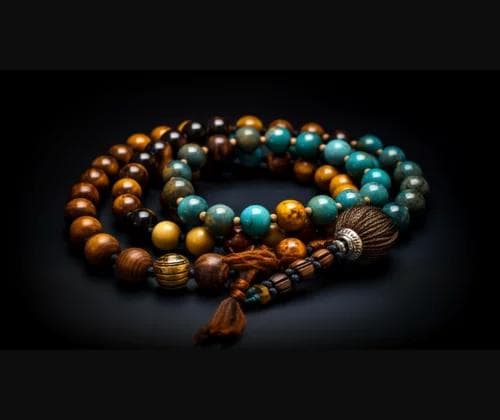
Philosophical
Prayer Beads in Religion: Malas, Rosaries, and Tasbih Across Faiths

Key Takeaways
- Prayer beads can be found in Buddhism, Hinduism, Islam, Christianity, and Sikhism. Their humanities' shared answer to keeping a restless mind anchored in devotion
- The repetition that is built in mala beads is not a normal ritual. It is a deliberate art of sacred words practice that trains you to focus your breath toward steadiness.
- Across malas, rosaries, and tasbihs, prayer beads are an act of sacred words made tangible, a way of holding devotion in your hands when your mind cannot hold it in thought.
What Are Prayer Beads?
Just for a moment close your eyes and imagine a series of smooth beads running through your fingers. One bead, one breath, one word of worship. Another one. And another one. No hurry. No urgency in this movement. Only rhythm. Prayer beads are one of the oldest forms of prayer known to humanity. This practice is alive today in temples, churches, mosques, and even homes around the world. Prayer beads are living tools held in billions of hands, with the same quiet purpose. The intent is to return a mind gone astray to the sacred. You can call them "mala beads" or "rosaries" or a "tasbih." Prayer beads exist wherever humans have searched for a way to hold their attention steady, anchored to a one divine source that traditions across the world call by many names
Prayer Beads Across Religions
Some truths are so universal that almost every spiritual tradition arrives at them independently. The common threads of prayer across religions are one of those truths. It is as if the soul itself remembers something that the mind has forgotten.
“The Rosary is a prayer that always accompanies me. It’s also the prayer of ordinary people and the saints…and a prayer from my heart.”
Enjoying this article?
Get UEF Insights. Writing on loving, learning, and playing, with insights from wisdom traditions and modern science delivered to your inbox.
“People count with self-satisfaction the number of times they have recited the name of God on their prayer beads, but they keep no beads for reckoning the number of idle words they speak.”
Prayer Beads in Buddhism
Buddhist prayer beads called malas are commonly used to count recitations of mantras or prayers during meditation or as part of devotional practices. A mala typically consists of 108 mala beads, representing the 108 kleshas, the mental afflictions that Buddhists seek to overcome through practice.
Prayer Beads in Islam
Islamic prayer beads, called "tasbihs," are used by Muslims to recite the 99 names of Allah, the Islamic creed (the Shahada), or other prayers and supplications. A typical tasbih consists of 33 or 99 beads, with a spacer or tassel marking the beginning and end.
Prayer Beads in Christianity
In Christianity, rosary beads are used by Catholics and some other Christian denominations as a tool for counting prayers, such as the “Hail Mary” or the “Our Father,” which are recited as part of the Rosary, a popular Catholic devotion. A typical rosary consists of five sets of ten beads (called decades) separated by larger beads, with a crucifix or a medal attached at the end.
Prayer Beads in Hinduism
Hindu prayer beads, called malas, are used for counting repetition of prayers, mantras, or chants during meditation or as part of devotional practices. Hindu malas can vary in size and number of beads but typically consist of 108 beads, representing the 108 sacred elements of Hindu cosmology, from sacred texts to deities to spiritual chakras
Prayer Beads in Sikhism
In Sikhism, a monotheistic religion originating in India, the use of prayer beads is not as common as in some other religions. Some Sikhs may use a small string of prayer beads called a 'mala' to recite mantras and affirmations such as the 'Ik Onkar' or the 'Mool Mantar,' the opening verse of the Sikh scripture, the Guru Granth Sahib.
What Prayer Beads Teach Us
Any tradition that has ever picked up a set of prayer beads is teaching the same quiet lesson about how the human spirit grows.
Love • Learn • Play
The formula for a meaningful life.
• Devotion is constructed, not invented
A mala or a rosary was never intended for one prayer. They are for coming back, for being there again tomorrow when today’s prayer feels ordinary.
• No separation of soul and body
To pray with something tangible in your hand honors the reality that we are not merely minds that can wander toward God, but also hands, breath, and touch.
• It Reinforces the power of repetition
Prayer beads serve as a quiet reminder in a society obsessed with novelty that depth often comes not from constantly seeking something new but from doing the same sacred thing many times over.
• Counting is sacred
Numbers like 108 or 99 are not random. They make an abstract longing for the divine into something countable, something attainable and completable.
• All traditions are reaching for the same horizon.
The words may be Sanskrit, Arabic, Latin, or Punjabi, but the gesture underneath is the same: asking for presence, humility, and connection to something greater than the self, much like the symbolism carried in light across so many of these same traditions.