
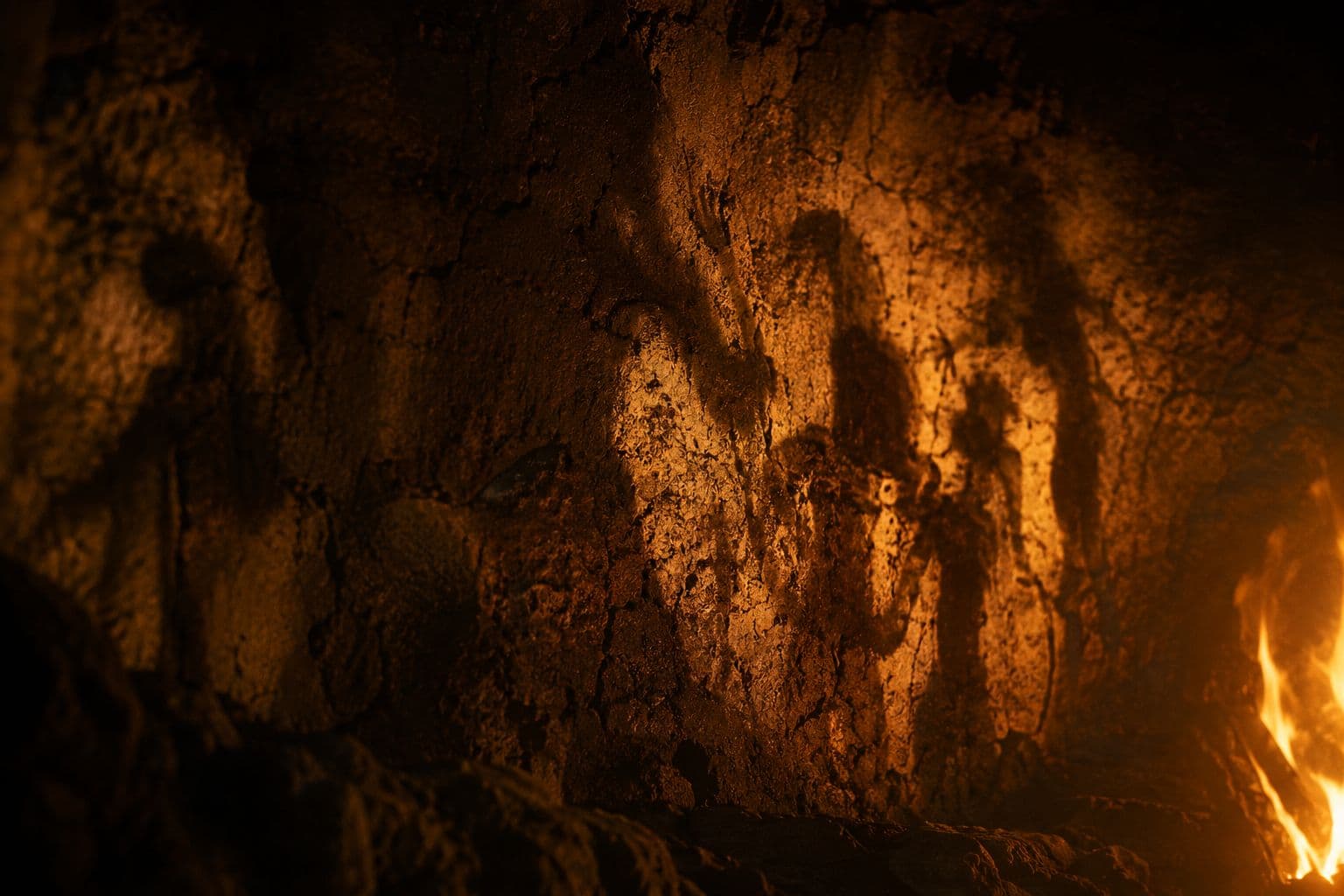

Plato's allegory of the cave is one of the oldest and most repeated stories in philosophy, a story about reality and illusion that still hits the same nerve it did 2,400 years ago. In The Republic, Plato imagines people chained inside a cave their entire lives, watching shadows flicker on a wall and believing those shadows are the whole of reality. They have never seen anything else, so they have no reason to doubt what they see.
That is the plato cave allegory in its simplest form: illusion mistaken for truth, and the long, difficult process of learning to tell the two apart. When people ask what does allegory of the cave mean, this is the heart of it. Plato is not just telling a story about prisoners. He is asking a question that never really goes out of date: how much of what you believe is really true, and how much is just the shadow of something you have never bothered to turn around and look at?
What makes the allegory endure is that almost every culture has landed on some version of the same idea, in different words, through different traditions, but circling the same truth.
What Does the Allegory of the Cave Mean
So what does the allegory of the cave represent? At its simplest: people trapped in a cave since childhood, chained so they can only face one wall. Behind them, a fire burns, and between the fire and the prisoners, people carry objects that cast shadows onto the wall the prisoners are forced to watch. Having never seen anything else, the prisoners assume the shadows are real. When one prisoner is finally freed and dragged into the sunlight, the light is blinding and disorienting before it becomes clarifying. Plato's real question is not about the cave itself. It's about what happens after: does the freed prisoner go back to tell the others, and would they even be believed if they did?
Hinduism and Buddhism have their own name for this same trap: Maya, the illusion that keeps people mistaking the surface of the world for its true nature. The goal of spiritual practice in both traditions is to see past Maya toward something more real. Other traditions reach for the same idea using different imagery, light breaking through darkness, and truth cutting through ignorance, but the shape of the story rarely changes. Even the question of what religion believes in karma connects here: how a person moves through illusion toward clarity is often tied to how they act and what they carry forward.
Plato’s Allegory of the Cave: Insights from Various Philosophical and Religious Traditions
Plato was not the only one to reach for this image. Strip away the specifics of each tradition and a strikingly similar shape appears again and again: darkness, illusion, and the difficult passage toward light.
Ancient Greece
"Behold! Human beings living in an underground den, which has a mouth open towards the light and reaching all along the den; here they have been from their childhood and have their legs and necks chained so that they cannot move and can only see before them, being prevented by the chains from turning round their heads. Above and behind them a fire is blazing at a distance, and between the fire and the prisoners there is a raised way; and you will see, if you look, a low wall built along the way, like the screen which marionette players have in front of them, over which they show the puppets." ,Plato, Ancient Greek philosopher
That fire behind the prisoners is doing more work in the story than it first appears; it's the false light that produces the shadows they mistake for reality. The same idea, fire as something that reveals but can also deceive, shows up across religious traditions in strikingly similar ways.
Enjoying this article?
Get UEF Insights. Writing on loving, learning, and playing, with insights from wisdom traditions and modern science delivered to your inbox.
Buddhism
"[Bodhidharma] faced the wall of his cave in zazen [meditation] for the last nine years of his life, though he had long ago found that wall, that barrier, to be altogether transparent." ,Robert Aitken, Zen Buddhist teacher and translator
Hinduism
"Few see through the veil of maya [...] Delusion arises from the duality of attraction and aversion, Arjuna; every creature is deluded by these from birth. But those who have freed themselves from all wrongdoing are firmly established in worship of me." The Bhagavad Gita, Hindu text
Krishna's teaching here is really a teaching about detachment: the same "duality of attraction and aversion" that keeps the prisoners chained to their shadows is what keeps anyone chained to illusion, and letting go of it is what makes clarity possible.
Christianity
"The people living in darkness have seen a great light; on those living in the land of the shadow of death, a light has dawned." ,The New Testament (Matthew 4:16,) Christian scripture
Islam
"Since you have distanced yourselves from them and what they worship besides Allah, take refuge in the cave. Your Lord will extend His mercy to you and accommodate you in your ordeal." , The Qur'an (18:16), Islamic scripture
Sikhism
"Within the cave of the heart, the Divine Light is shining. Focus your meditation upon the Divine Light and all your doubts shall be dispelled." ,Guru Nanak, founding Sikh prophet
Interpreting the Allegory of the Cave: What It Means Today
What ties all of this together, Plato's prisoners, Maya, and the divine light Guru Nanak describe, is the same basic insight: ignorance rarely feels like ignorance from the inside. It feels like knowledge. That's what makes the interpretation of the allegory of the cave so useful outside a philosophy classroom. It's not really about ancient prisoners. It's about how easy it is to mistake a partial view for the whole picture and how much courage it takes to question something you've never had a reason to doubt.
Here's what each part of the story stands for, and where you might already recognise it.
Glossary
Allegory of the Cave
One of Plato’s most famous ideas is his allegory of the cave. This is also a story of perception vs reality. It shows how easy it is for people to fall into what they think they already know. The danger is to think that what you see is the whole truth. The way out is to doubt, to think hard, to be willing to be wrong. That is the entire arc of the story: from certainty about shadows to a harder, better kind of knowing.
Plato's Allegory of the Cave
It is one of the most powerful and enduring metaphors of Plato, found in the Republic. He shows prisoners chained in a cave, mistaking the shadows on the wall for reality itself. These prisoners are the human condition writ large, chained down by illusion and limited perception until they eventually walk into the light and find out what freedom through truth really feels like.
Allegory Meaning
Allegory is a story in which symbols are used to express a deeper meaning, moral, spiritual, or political. Plato’s cave is the metaphor of human ignorance and knowledge-seeking, of the travel from darkness to light, from not-knowing to knowing. This is a graphic example of how a shift in consciousness can totally change the way a person perceives the world.
The Cave
In the allegory of the cave, what does the cave represent? Illusion, limitation, and misunderstanding the seeing of one narrow slice of truth and the mistaken belief that it is the whole. A modern parallel is easy to spot: living in a media bubble or echo chamber does something very similar.
Prisoners
The prisoners are average people, limited by their own ignorance and social conditioning, people who accept the surface level of truth without ever questioning if there is something more underneath. Today, that’s anyone who thinks a curated feed or filtered version of events is the whole story.
Chains
The chains represent whatever keeps a person from seeking real knowledge: fear, habit, false beliefs, inherited narratives, and social pressure. Imagine mental barriers, biases, or cultural conditioning that silently limit how open-minded someone actually is in modern term.

Love • Learn • Play
The formula for a meaningful life.
Shadows On The Wall
The shadows are illusions, distorted reflections of reality created by the senses or by external influence. They represent how easily people mistake imitation for the real thing.
That's what the it's an illusion meaning really comes down to in a single image: media and manipulated information are the modern equivalent of shadows on a wall.
The Fire
The fire is the artificial light source that produces the shadows in the first place. Not the illusion itself, but what makes the illusion: incomplete knowledge, dressed up as the real thing. The modern version is partial truths and partial information, delivered with the utmost conviction.
The Escape / Freed Prisoner
This is the awakening of the mind, the person who begins to ask questions about what has been shown to them, and seeks something truer underneath. Enlightenment is what happens at the end of that inquiry. That is, in terms of today, the critical thinker who won’t accept the accepted version of things until they check it out first.
The Journey Upwards
This is the process of learning, self-awareness, and intellectual growth, the difficult but necessary climb from ignorance toward wisdom. Nobody makes this climb instantly.
The Outside World
This is the higher plane of reality and truth, the realm of true understanding beyond illusion and limited perception. The modern equivalent is a clarity that comes only from real experience, honest reflection, and continued learning, not from second-hand impressions.
The Sun
The sun is the Form of the Good, the ultimate truth revealing everything else and making real knowledge possible in the first place. In modern terms, this is enlightenment, wisdom, or whatever shows us reality for what it really is, instead of what it's been dressed up to look like.
Beyond the Cave: What Enlightenment Is For
Plato’s story generally ends with the prisoner’s exit from the cave. But underneath it is a harder question: what do you do, really, with the light once you’ve seen it? The question is when the allegory begins to look less like ancient philosophy and more like a picture of what it means to flourish.
UEF's Love, Learn, Play framework maps onto that journey in a way that feels almost built for it. The cave climb is learning, the slow, often uncomfortable work Plato describes as exchanging ignorance for understanding. And what does the freed prisoner decide to do at the top? Love. Because in Plato's own version of the story, the prisoner does not stay in the light by himself . He descends again to those who are still chained. It is this readiness to return for others that gives the entire ascent its significance. And the sheer disorientation and wonder of stepping into the sun for the first time, that’s play, the curiosity that keeps a person seeking rather than settling once the questions get hard.
Learning to see clearly, caring enough to go back for others, and never losing the wonder of the light: together, that's what a flourishing life looks like once you're out of the cave.