


Introduction
The Hindu concept of bliss turns our attention away from temporary satisfaction and towards the happiness found within. Hindu teachings encourage seekers to deepen this awareness through believing in a higher power, spiritual practice and service to others.
At its heart, this is what UEF means by flourishing: a life that grows not from chasing success, but from loving and serving others, learning about ourselves, and finding joy in the present moment. Ananda is the fruit of all three.
What Is Ananda? The Hindu Concept of Bliss Explained
The word “Ananda” (pronounced as "Ah-nun-da") is a Sanskrit word and is widely used in Hinduism, Buddhism, and Jainism. In Sanskrit, 'Ananda,' meaning 'bliss,' is the ultimate state of contentment.
A Sanskrit expression, "Sat-Chit-Ananda," aptly describes the Self or the entire Brahman. It can be broken down into three essential elements. Where “Sat" stands for Truth or Being, "+" "Chit" refers to Consciousness, & “Ananda” means divine bliss. They may seem as three separate chants; however, they are not separate entities. They are part of our soul, or "Atman," and co-exist together.
Sat-Chit-Ananda describes the ultimate Self through three connected ideas. Sat means eternal existence, the part of the Self that does not change or disappear. "Chit" means pure consciousness, the awareness through which we experience and understand life. Ananda means the deep bliss that arises from knowing our true nature. Together, Sat, Chit, and Ananda describe the ultimate Self as eternal, conscious, and complete. They also express the oneness of being, consciousness, and bliss rather than three separate parts of the Self.
Ananda in the Upanishads and Bhagavad Gita
"Ananda," or the ultimate bliss in spirituality, is mentioned many times in various scriptures and Hindu teachings.
Let us take a closer look:
Taittiriya Upanishad
"Ananda," meaning in Vedanta also referred to as Upanishads is described using the term – "Satyam, Jnanam, Anantam," meaning Truth, Knowledge, and Bliss . In simple terms, the state of ultimate bliss is intrinsic and can be attained through complete knowledge of the Self.
Bhagavad Gita
In the Bhagavad Gita verse 5.21, Lord Krishna describes the true essence of a yogi. He states that those who are not attached to external sense pleasures realize divine bliss in the self. The ones who remain united with God through Yog only experience unending happiness. Lord Krishna further states in Bhagavad Gita verse 5.24 that he who is happy within, who rejoices within, and who is illuminated within - that yogi attains the supreme bliss.
Enjoying this article?
Get UEF Insights. Writing on loving, learning, and playing, with insights from wisdom traditions and modern science delivered to your inbox.
Yoga Sutras of Patanjali
“Ananda” in the Yoga Sutra of Patanjali refers to the ultimate meditative stage of bliss. It describes a state in which one merges with the divine inner self and is filled with love and pure joy. This meditative state can be experienced only after quietening the thoughts and surpassing all the mental clutter.
How Ananda Is Different From Happiness
Now that we have understood what “Ananda” is in Hinduism, Let us look at the difference between spiritual bliss and happiness.
| Aspect | Happiness | Ananda (Bliss) |
|---|---|---|
| Source | External (events, achievements) | Internal (self-realisation) |
| Duration | Temporary | Eternal |
| Dependence | Circumstantial | Independent of circumstances |
| Experience | Emotional pleasure | Deep contentment and spiritual joy |
| Example | Joy from success | Bliss in meditation or spiritual insight |
We need to understand that happiness is achieved through extrinsic rewards and is temporary in nature. What does the Hindu religion teach us?However, the eternal bliss meaning associated with Ananda points to a contentment that does not disappear when circumstances change. It is discovered through self-knowledge and a deeper awareness of the divine within. The Vedic scriptures repeatedly describe God as an ocean of unlimited divine bliss. The state of Ananda is cultivated through sustained devotion and unwavering awareness of the divine.
How To Experience Ananda In Today’s Life
In Hindu thought, the meaning of the path of bliss is simple to state and hard to live: accept every day, every moment, every event, every thought, and every emotion; and resist none of it. We should try to embrace life and not shun it.
These practices also reflect UEF’s Love, Learn and Play framework. Together, love, learning and joyful engagement can support a flourishing life.
Meditation & Mindfulness
Mindfulness means being present in the moment, and meditation is a process of training our minds to remain calm, focused, and compassionate even in difficult times. That’s why so many spiritual traditions and scriptures encourage meditation in the early morning hours. It is one of the most meaningful ways to gently calm the mind and help create a sense of inner balance. A simple bliss meditation may begin with a few minutes of quiet breathing. You can then observe your thoughts without holding on to them.
Selfless Service (Seva)
The next step on the path is Seva, meaning selfless service. It is a voluntary act of helping others without expecting anything in return. It can help a person get a step closer to achieving “Ananda” in modern life.
Spiritual Inquiry (Jnana Yoga)
Once we set out on this path of wisdom, we would reach a stage where our minds would seek inner clarity and invariably ask questions related to our own existence and purpose. As we seek answers to them, we will set forth on the path of spiritual awakening and discover our true selves.
Detachment (Vairagya)
As the devotees move forward on the spiritual path, they begin to develop Vairagya or detachment. It’s not about withdrawing from life or being emotionally numb. Rather, it is about loosening the constant need for approval, control, or attachment to results. This creates a quiet sense of freedom and emotional balance. UEF’s discussion of the law of detachment explores a similar freedom from the need to control every result.
Spending Time Outside
You can also experience spiritual joy and inner stillness by spending time in nature. Whether it’s sitting near the ocean, walking through the forest, or watching the sunrise in silence, nature has a way of slowing the mind and helping people reconnect with themselves.
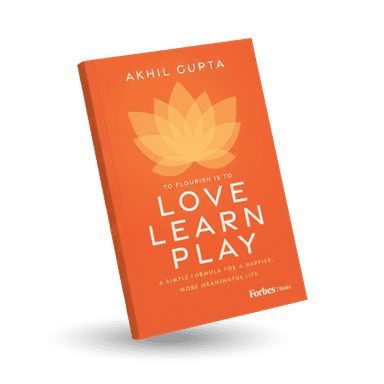
Love • Learn • Play
The formula for a meaningful life.
How to Find Bliss: Hindu Teachings on Happiness in Daily Life
Here are some small daily habits that can gradually bring more awareness, balance, and peace into everyday life.
Hindu teachings present meditation, seva, vairagya and self-inquiry as practical ways of moving towards Ananda. Each practice helps remove a different barrier to inner bliss, such as mental restlessness, self-interest, attachment or a limited understanding of the Self.
Meditation
Meditation is the practice of quietening the mind and observing thoughts without becoming carried away by them. Begin with five quiet minutes each morning and return your attention to the breath whenever the mind wanders.
Seva
Seva means helping others without expecting praise, payment or recognition. Practise it by supporting someone in need, volunteering locally or doing an ordinary act of kindness without seeking anything in return.
Vairagya
Vairagya means loosening our attachment to possessions, approval and results. Practise it by doing your work sincerely while accepting that the outcome may not be entirely within your control.
Self-Inquiry
Self-inquiry involves looking beyond changing thoughts, emotions and social roles to understand the true Self. Set aside time to ask, “Who is experiencing this thought?” or “What am I seeking from this achievement?” and sit quietly with whatever arises.
These practices do not promise constant pleasure or an escape from difficulty. They offer a way to develop steadiness, self-awareness, and contentment in everyday life. This is central to Hindu teachings on bliss and contentment.
You can also explore your own spiritual growth journey on the wisdom map today.
Conclusion
True contentment arises from self-knowledge, inner discipline, and a deeper relationship with the divine.
Some of the practices that enable the seekers to move towards Ananda, the state of eternal bliss and inner contentment, are meditation, Seva (selfless service), devotion, self-inquiry, and Vairagya. In Hindu philosophy, this journey is not an escape from life but a deeper understanding of life.
Ananda, then, is not a reward for the few. It’s what happens naturally when we surrender ourselves to love, to learning and to play, the same three longings that UEF sees at the heart of a flourishing life. If you want to delve into these ideas, UEF has tools to find universal truths, the wisdom found in all spiritual traditions, and the way to thrive.