

Why We Optimize Everything Except the Things That Actually Matter
You track your habits, journal everything, read books, follow the routines, and hit most of your targets. On paper, everything looks good, yet, somewhere underneath all of it, a question keeps resurfacing: what is all of this actually for?
We have become extraordinary at self-optimization. We manage our calendars with so much precision, scale careers, engineer our mornings, and track our sleep cycles to the minute. But for all this skill, we remain surprisingly poor at living in the moment.
Universities teach us finance, coding, and leadership. Spirituality stays shelved to the elective section. As we graduate, we become highly capable people, well equipped to succeed and poorly equipped to feel fulfilled. This is the paradox at the heart of modern personal development. We are all on a self-improvement journey but rarely ask where the road leads.

What Is Self-Improvement?
Self-improvement means the conscious and deliberate effort we make to develop our habits, skills, character, and outcomes. It is rooted in a tradition as old as Aristotle, and it is talked about everywhere, like your favorite self-help podcast. Aristotle used to call it 'eudaimonia,' or human flourishing through virtue, while Durant captured it simply by saying, 'We are what we repeatedly do.' Excellence, then, is not an act but a habit.
The philosophy of self-development says that you're not born finished; you are raw material, so shape yourself deliberately. This path has real power. It gives you agency to build accountability and transform vague aspirations into actual progress.
But the thing is that when personal growth becomes the only measure of worth, the self becomes a perpetual construction site. There is always going to be another habit to build, another metric to beat, another version of yourself to achieve, and the project is never done.
What Is Spiritual Awakening?
Spiritual awakening is not reserved just for monks on mountaintops. At its simplest, the spiritual awakening meaning is this: it is a shift in perception, a deepening recognition of who you actually are beneath your roles, achievements, and thoughts. You do not need to abandon your ambition, religion, or anything else for spiritual awakening. As explored in Can You Be Spiritual But Not Religious? spirituality and religion are not synonymous. Awakening is available to anyone who's willing to turn inward.
Enjoying this article?
Get UEF Insights. Writing on loving, learning, and playing, with insights from wisdom traditions and modern science delivered to your inbox.
Across different traditions, this inner transformation points to the same core recognition: that your deepest nature is already whole. The insights from Vedanta and the Upanishads offer a clear map of this territory.
Buddhism points to anatman, or no self, which is the liberating recognition that what you thought was a solid, fixed self is actually fluid, open, and free. In Christianity, Jesus said the kingdom of God is within you. Across these common themes in all religions, the core message is the same.
As Lao Tzu (Daoist philosopher) put it, "Knowing others is intelligence; knowing yourself is true wisdom."
The signs of spiritual awakening are often quiet. A deepening stillness, a loosening grip on outcomes, a growing ability to witness your thoughts rather than be ruled by them.
Modern neuroscience adds another layer of validation. Long-term contemplative practice measurably reduces activity in the default mode network. It is that part of the brain that is responsible for rumination and self-referential thinking.

Why Self-Improvement Sometimes Feels Empty
We are told often that our value is conditional, tied up in titles and income and numbers of followers and the perfect public facades. But these are false narratives, not natural human needs. They are socially constructed desires, and in pursuit of them you can get stuck in a loop of perpetual striving with no arrival point in sight.
That’s why so many people feel empty when it comes to self-improvement. The question is, what comes next after self-improvement? That question is an indication of readiness to ask deeper questions that lead to spiritual awakening.
What is the Real Difference Between Self-Improvement and Spiritual Awakening
In the conversations about spiritual awakening versus self-improvement, one can think of these two terms as opposites. They're not. They're just asking different questions from different levels of the same life. This is where the difference between spiritual growth versus self-improvement shows up.
| Aspect | Self-Improvement | Spiritual Awakening |
|---|---|---|
| The core question | Asks, "How can I be better?" | Asks, "Who is the one asking?" |
| The basic move | Adds value | Releases what isn't needed |
| The starting assumption | Assumes something is wrong | Starts from the recognition that nothing fundamental is broken |
| Ego | Strengthens the ego | Sees through the ego |
| Consciousness vs. personality | Refines your personality | Connects you to the awareness behind it |
| Being vs. doing | Is what you do in the world | Is the awareness that holds all the doing |
How Love, Learn, Play Bridges Both Worlds
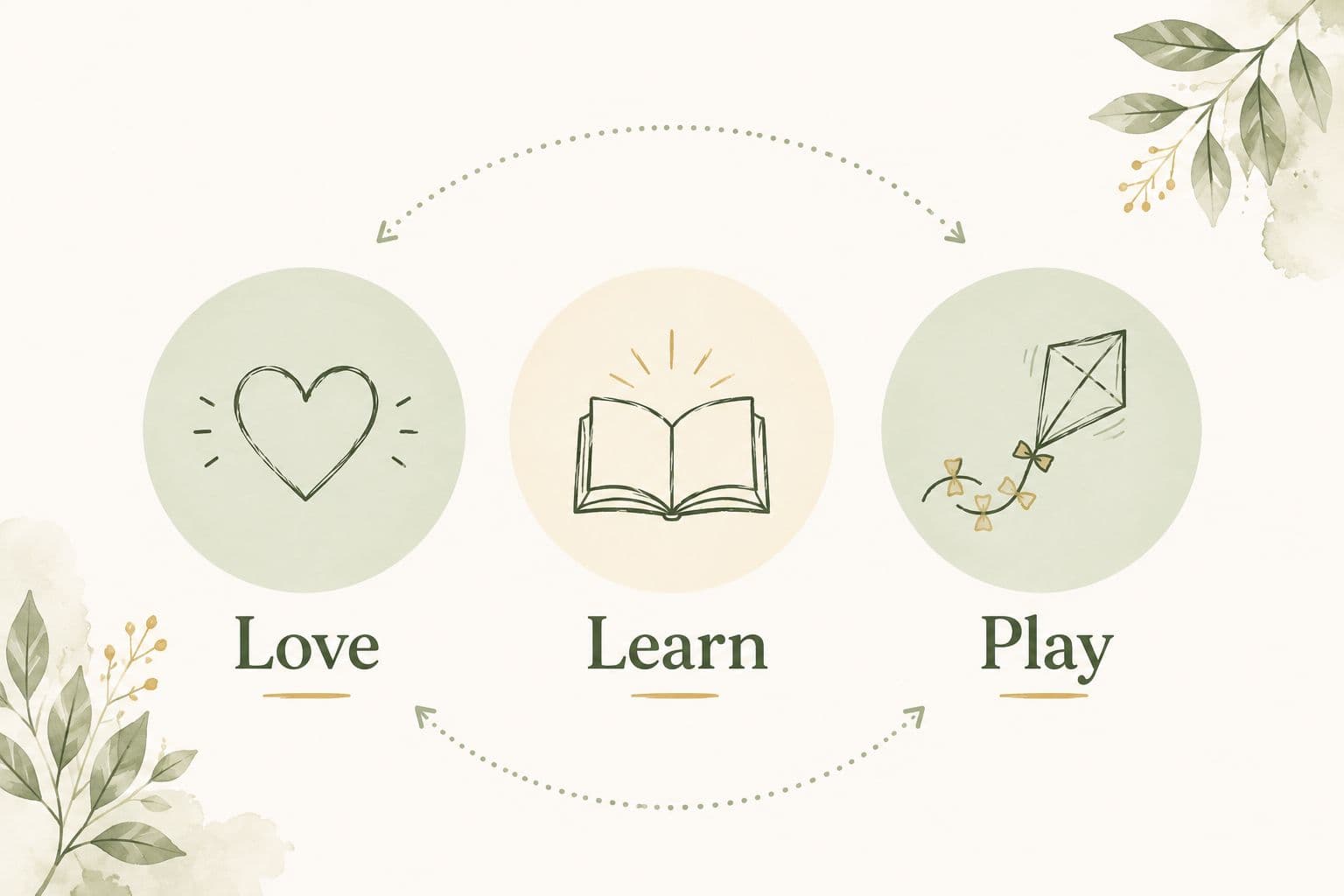
Love, Learn, play is a framework that does not ask you to choose between ambition and stillness. It asks you to bring awareness to both and let each one inform the other.
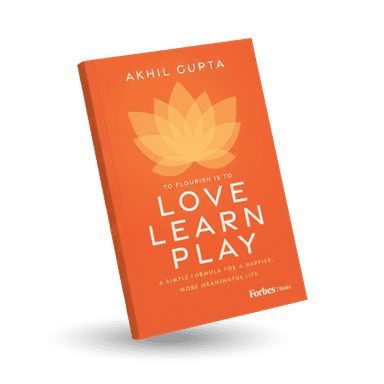
Love • Learn • Play
The formula for a meaningful life.
Love
Love is not an obligation or a duty. It is an internal outpouring of care for yourself, others, and the life that you're building. Duty makes us do things well, but love makes us do them beautifully.
Learn
Self-improvement is all about learning to fix, and awakening is about learning to see. Love, Learn, and Play can integrate both. You learn to stay curious about how to live better and stay curious about whether what you are chasing is what you actually want.
The curious paradox is that when I accept myself just as I am, then I can change. - Carl Rogers
Play
Self-improvement can turn life into a game with points. Awakening teaches that there are no points to keep. Play reclaims joy for its own sake.
Instead of calling it work, realize it is play. - Alan Watts
Play reminds you that not every part of life needs to become productive. Sometimes enjoyment is enough on its own. In a culture built around constant improvement, that can feel surprisingly difficult to remember.
Conclusion
We’ve created great machinery for living well, and somewhere along the line, that machinery became the whole point. The way back is not to abandon the work of getting better but to let deeper questions guide our actions. Those questions are the ones spiritual awakening asks.
'Love, learn, play' is one of the simplest, most honest frameworks, offering a more practical way of life, a way to bring awareness to your ambition, warmth to your growth, and joy to your becoming, the foundation of a genuinely flourishing life. That is spiritual transformation in the most down-to-earth and human sense.