

Introduction
When you stop fighting, you get to see.
And what you get to see, you love.
Not because it became perfect,
but because you stopped wanting it to be so.
Is acceptance the same as giving up? It is not. It is not a shrug or a quiet surrender that looks like giving up because it is easier than fighting. Acceptance is far sturdier than that. It is the ground you stand on before you take your next step. Therapists call this radical acceptance. This is a term that entered the language through modern psychology. In dialectical behavior therapy, it is the skill of tolerating a painful reality without demanding it be otherwise. But the idea behind it is not modern at all. Long before it had a clinical name, it had a home in four of the world's greatest wisdom traditions. It also runs alongside what the law of detachment describes, the practice of full engagement without the grip of outcome.
A Buddhist monk in a meditation hall learning to sit with discomfort. A Stoic philosopher writing to himself by candlelight, trying again to make peace with what he cannot control. A Muslim who has done everything he can and now releases what comes next into God's hands. A Hindu sage who wakes up the same person regardless of whether yesterday went well or fell apart.
Different centuries, different continents, and different languages arrive at the same discovery: that you cannot build a good life by refusing to live the one that you actually have.
What Is Radical Acceptance? The Modern Term With Ancient Roots

The radical acceptance meaning that most people carry around is thin. It sounds like defeat. But that is not it.
Radical acceptance means seeing reality exactly as it is, without the extra layer of suffering that comes from insisting it should be otherwise. Your pain is real either way. But there is the pain itself, and then there is the second pain you add by fighting the fact that the pain exists at all.
A person can accept a loss and still grieve it fully and rebuild afterwards. The means-ends inversion happens when we grip the outcome so tightly that we lose the peace the outcome was supposed to bring. Acceptance is the antidote that clears the fog so that you can see what is actually in front of you and act from there, instead of from within denial.
Enjoying this article?
Get UEF Insights. Writing on loving, learning, and playing, with insights from wisdom traditions and modern science delivered to your inbox.
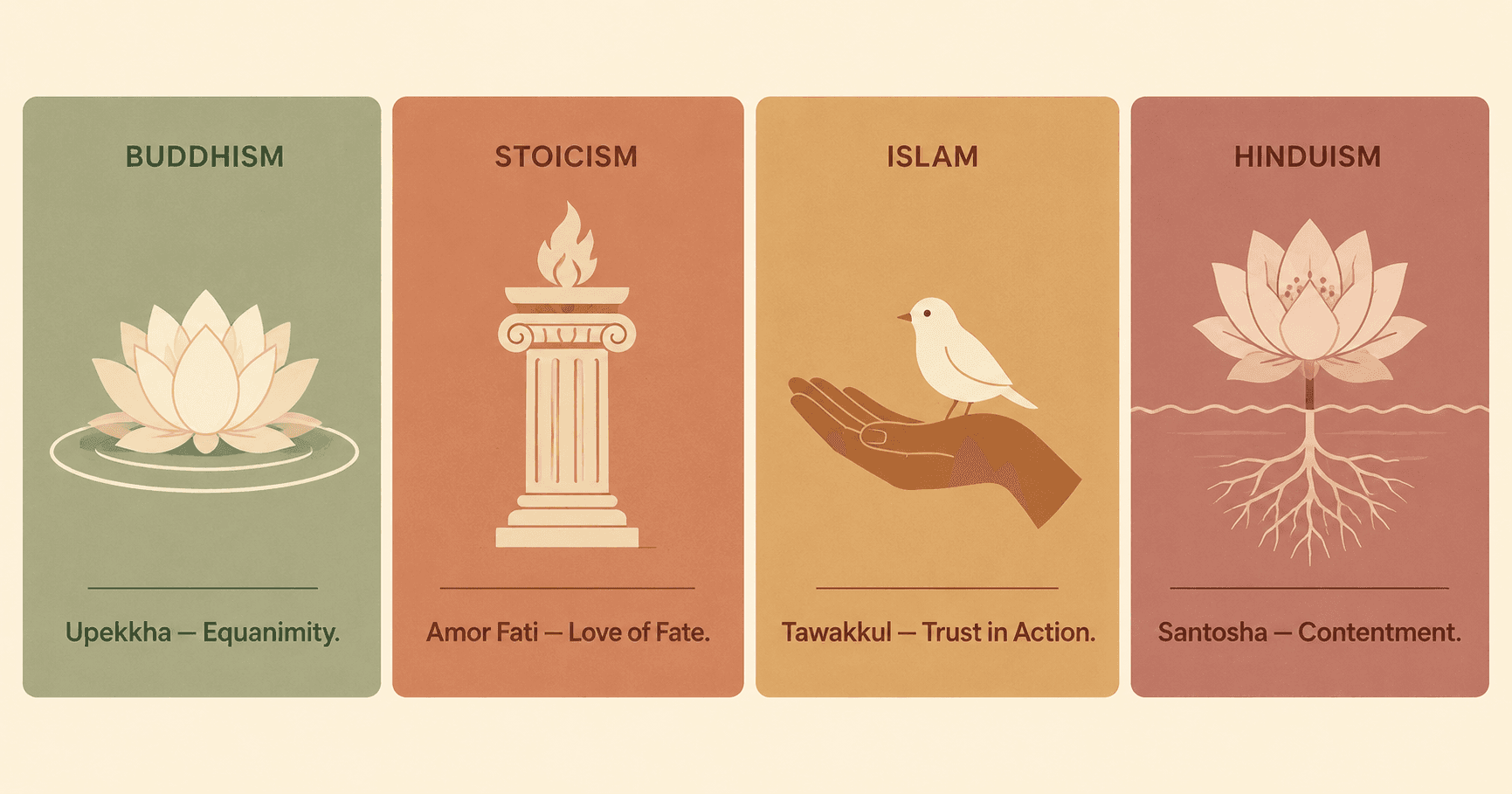
Four traditions have reached the same place from four different directions, and here is what each one found.
Upekkha: The Buddhist Understanding of Acceptance and Equanimity
In Buddhist teaching, upekkha is translated as equanimity. There is no single English word that can carry the weight of its meaning. It is one of the four qualities the Buddha called the Brahma-viharas. It is the sublime state of a heart that has stopped bracing against life. Acceptance in Buddhism and mindfulness are deeply linked.
Upekkha is what allows love to stay steady even when circumstances change. Without it, love can turn into clinging, and clinging turns into suffering.
Practicing acceptance in the Buddhist sense starts small. Here is how it works. You notice a feeling arise, pleasant or not, and let it be there without immediately trying to push it away or hold on to it. Over time, this becomes less of a technique and more of a way of meeting each moment.
Amor Fati: The Stoic Art of Loving Your Fate
The Stoics had a phrase for this: Amor Fati, love of fate. Nietzsche later picked it up and sharpened it, but the root belongs to Stoic philosophy and to thinkers like Epictetus and Marcus Aurelius. Some things belong to you and some things don’t. As soon as you stop spending your energy on the second category, you start to have peace. Amor fati vs acceptance is not a contradiction. It asks you to really welcome every moment, to see every event, even the hard ones, as something you can work with, not as an obstacle between you and the life you wanted. Marcus Aurelius was writing to himself, not to an audience, reminding himself, again and again, that obstacles are not separate from the path. This is where acceptance meets change. Loving your fate does not mean that you have to stop trying to improve your circumstances. It means that you stop wasting energy resenting the circumstances that you're working with right now.
Tawakkul: The Definition Of Trust and Surrender in Islam
In Islamic tradition, tawakkul describes a reliance on Allah that runs alongside action instead of replacing it. A well-known teaching captures the balance directly: do the work fully, and then release your grip on what happens next. Because what happens next was never yours to hold. This is one of the most misunderstood ideas across religious traditions because Tawakkul can be mistaken for passive fatalism, the idea that nothing you do matters since everything is already decided. Tawakkul vs fatalism is a distinction the tradition is careful about.
Acceptance in Islam, what the tradition calls tawakkul, demands effort. It refuses to let anxiety over the outcome be the price of the effort. In this light, acceptance vs surrender is not such a contradiction after all. Surrender here is not the abandonment of effort. It is the release of a burden that was never meant to be carried alone.
Santosha: What is Acceptance and Contentment in Hindu Philosophy
Acceptance in Hinduism finds its clearest expression in santosha, one of the niyamas in the yoga sutras. It is the inner observance that shapes a life practiced with intention. Santosha vs contentment is worth understanding. Santosha meaning is usually rendered the same as contentment, but it points at something more precise. It is a serene kind of peace that is a baseline that doesn’t come and go with the circumstance. It’s not the same as having no ambition or want. It’s the difference between wanting more from a place of peace and wanting more from a place of scarcity. This is where the acceptance spiritual meaning becomes practical. A person that is practicing Santosha still can aim for a better job or better life. This is also what self acceptance means in the Hindu sense, not approval of every action, but a recognition that the self doing the work is already enough. Self acceptance meaning is not earned. It is uncovered.
Love • Learn • Play
The formula for a meaningful life.
Radical acceptance is not the endpoint. Acceptance and letting go move together. One is a seeing. The other is a releasing. But they follow each other naturally. It clears the ground for everything else.
From the lens of Love, Learn, Play framework, you can't fully love someone if you're busy resisting. You can't learn from a moment you refuse to be in. And you can't play in the true sense of lightness while holding onto how things should be instead of how they are.
Conclusion
Upekkha. Amor fati. Tawakkul. Santosha. Across these four teachings, one thread remains. None of them tell you not to care, not to try, not to want a better life. They are asking you to stop adding resistance to what already is. Acceptance vs resistance shapes whether your life feels like a fight or a practice.
This is what human flourishing looks like in practice. It is not a life without hardship, but a life no longer bowed under the added weight of refusing it. That is also what inner peace is, not an absence of difficulty, but an absence of war with it.