There’s a tendency to talk about mindfulness as if it’s something new, packaged for a modern mind that scrolls too much and rests too little. Mindful practices are older than the word itself. Long before attention was measured in an app, humans on every continent were asking the same question in the temple grounds, mosques, forests, and beyond. How do I stop living somewhere else and start living in the now? This is not a comparison of which faith does it best. It is an invitation to practice mindfulness by joining a lineage far older and far wider than any tradition. How do you practice mindfulness? How can I practice mindfulness without a teacher or a tradition? These are the right questions. And four of the world's oldest wisdom traditions have already answered them.
Mindfulness across religions looks different on the surface. Buddhist sati, Hindu dhyana, Christian contemplative prayer, Islamic salah and dhikr, and Jewish kavanah. But mindfulness practices by religion all converge on the same movement: returning to now. Islamic mindfulness practices are built into the structure of the day itself. Buddhist ones begin with the breath. Hindu ones begin with the witness. Christian ones begin with silence. Jewish ones begin with intention.
Buddhist Mindfulness Practices: Sati and Vipassana
If the mind is left untended, it runs like water downhill. Buddhism asks you to notice where it goes.
Sati is the Pali word for mindfulness and is often translated as "to remember." It means remembering to come back again and again to what is happening now. It's not a technique; it's a homecoming that has to be practiced thousands of times every day.
Vipassana means seeing clearly. It is a practice of observing the breath in and out. Watching the mind wander, judge, grasp, and relax.
A thought appears, you notice it, you let it pass, like weather across a wide sky. It is also one of the quietest paths toward what is inner peace in the Buddhist sense, a stillness that does not require achieving anything.
How Hindus Practice Mindfulness Through Dhyana and Witness
Before there was a word for meditation in the West, there was dhyan, the art of becoming the one who watches, rather than the one who gets swept away.
In Hindu philosophy, dhyan refers to an unbroken flow of attention towards the self that observes. The Bhagavad Gita speaks of the steady mind as a lamp that does not flicker in a windless place, undisturbed by the noise around it. It is not the absence of thought, but the presence of a witness who's no longer at the mercy of every passing thought.
Central to this tradition is the idea of the sakshi, the part of you that watches your emotions rise and fall without becoming them. This distinction alone is one of the most practical mindfulness strategies a person can carry into their life.
Enjoying this article?
Get UEF Insights. Writing on loving, learning, and playing, with insights from wisdom traditions and modern science delivered to your inbox.
Yoga, in its original and fullest sense, was never only a physical practice. It was a path of union between mind, breath, and body, brought into a single focus. Mindfulness focus is not something you force. It is something you return to gently. This is the oldest mindfulness focus exercise there is: notice you have wandered, and come back. The connection between mindfulness and focus in Hindu teaching is not incidental. The sakshi, the witness, is also what makes sustained attention possible.
Christian Mindfulness Practices: How Contemplative Prayer Links Us to the Present
Christianity’s relationship with mindfulness is that it does not wear that word. Mindfulness and presence in Christianity do not go by that name, but the practice is unmistakable.
Christian people fell back into silence long before "digital detox" was a phrase. They looked for the prayer of the heart, an attention to the presence of God that was wordless, beneath the noise of daily life. Contemplative prayer vs meditation is a distinction worth making. Both involve sustained attention and inner stillness. But contemplative practice is directed toward God, while meditation in the Buddhist or Hindu sense is directed toward the nature of mind itself. The stillness is the same. The orientation differs: contemplative prayer was further developed by the Trappist monks who developed centering prayer, asking the person to give up words altogether. Rather than a mantra to chant mindlessly, you selected one sacred word to use as a gentle hand that would bring your attention back each time it strayed.
Islamic and Jewish Mindfulness Practices: Dhikr, Salah, and Kavanah
In Islam, mindfulness lives most visibly in Salah, the five daily prayers that are structured around the rhythm of the sun. Salah is not just a ritual but a built-in return to presence, a way of practicing mindfulness at work, at home, mid-conversation, mid-errand, and beyond.
Alongside Salah sits Dhikr, the remembrance of God through repeated phrases. Sufi mystics took this further still, using Dhikr as a doorway into complete absorption, just like the way a drop of water dissolves into the sea. Judaism carries the concept of Kavanah, which means intention or directed heart. A prayer that is said without kavana is a body without breath. Kavana asks the same question that every contemplative tradition arrives at. Are you actually present here or simply going through the motions of being here?
Simple Mindfulness Exercises From Five Spiritual Traditions You Can Try Today
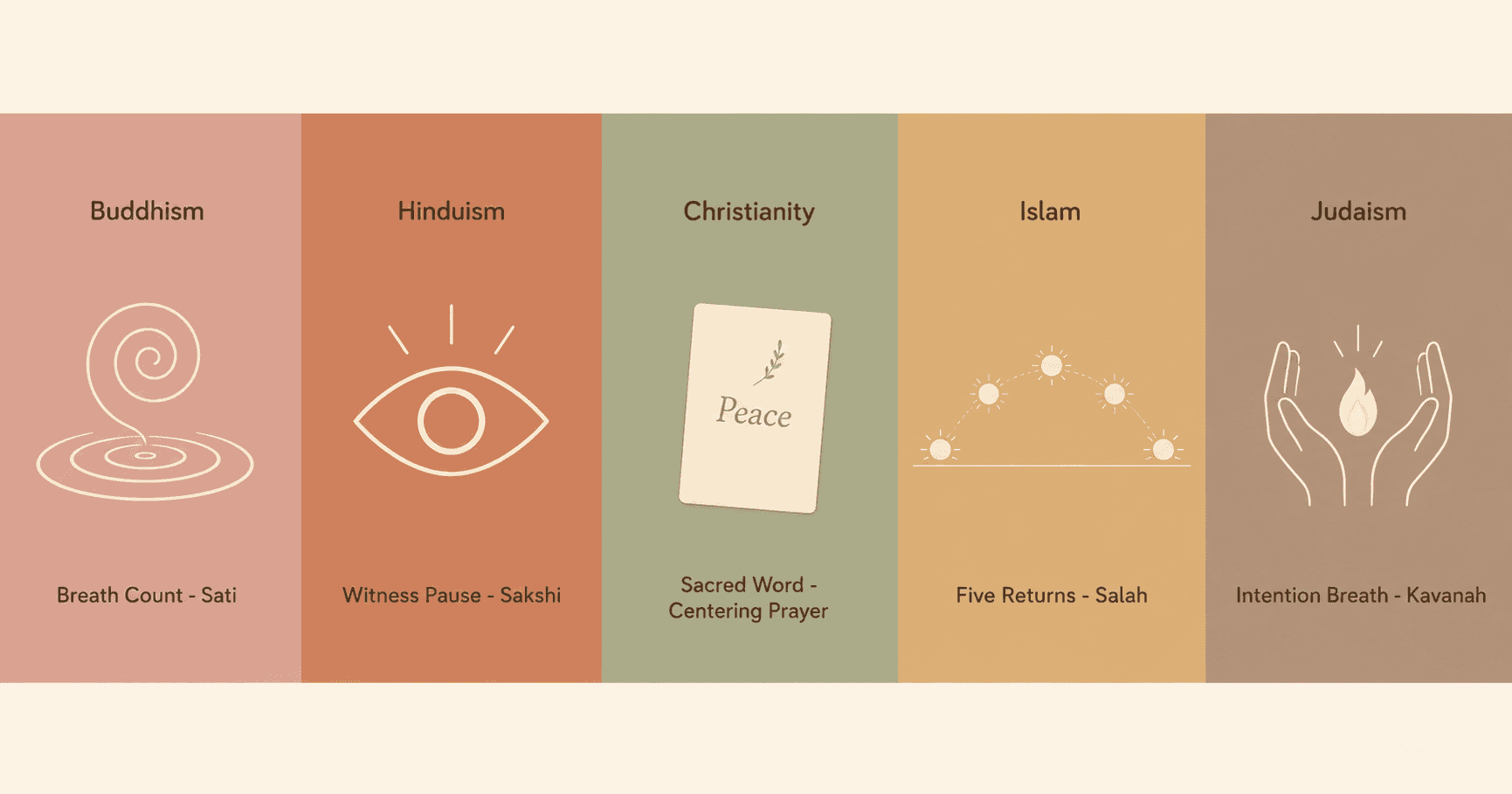
Looking for easy mindfulness tips for beginners? These five exercises need nothing but a few minutes and a willingness to notice. No robe, no pew, no prayer mat required.
If you want to know about practical mindfulness exercises for everyday life, here are five different mindfulness practices that are drawn from each tradition. Each one shows how to practice mindfulness in everyday life without needing to set aside special time or find a quiet room.
Love • Learn • Play
The formula for a meaningful life.
- The Breath Count (Buddhist-inspired)
Sit for five minutes and simply count ten breaths, restarting at one whenever your mind wanders. This is one of the simplest mindfulness exercises for focus, borrowed directly from vipassana.
- The Witness Pause (Hindu-inspired)
When a strong emotion rises, silently name it: “anger is here,” “worry is here.” You are not suppressing it. You are stepping back into the witness, exactly as Dhyana teaches.
- The Sacred Word (Christian-inspired)
Choose one calming word. Each time your thoughts drift during a quiet moment, return gently to that word, the way Centering Prayer intends it.
- The Five Returns (Islamic-inspired)
Pick five fixed points in your day: waking, a meal, a commute, evening, bedtime, and pause for thirty seconds of full attention at each. This is how to practice mindfulness at work without ever needing to leave your desk.
- The Intention Breath (Jewish-inspired)
Before starting any task, take one breath and ask, "Am I bringing my full self to this?” This is an example of a small echo of kavanah, carried into modern, ordinary life.
These five mindfulness examples are each drawn from a living tradition. They are also examples of mindfulness practices that require nothing you do not already have : no equipment, no expertise, no prior experience
Conclusion
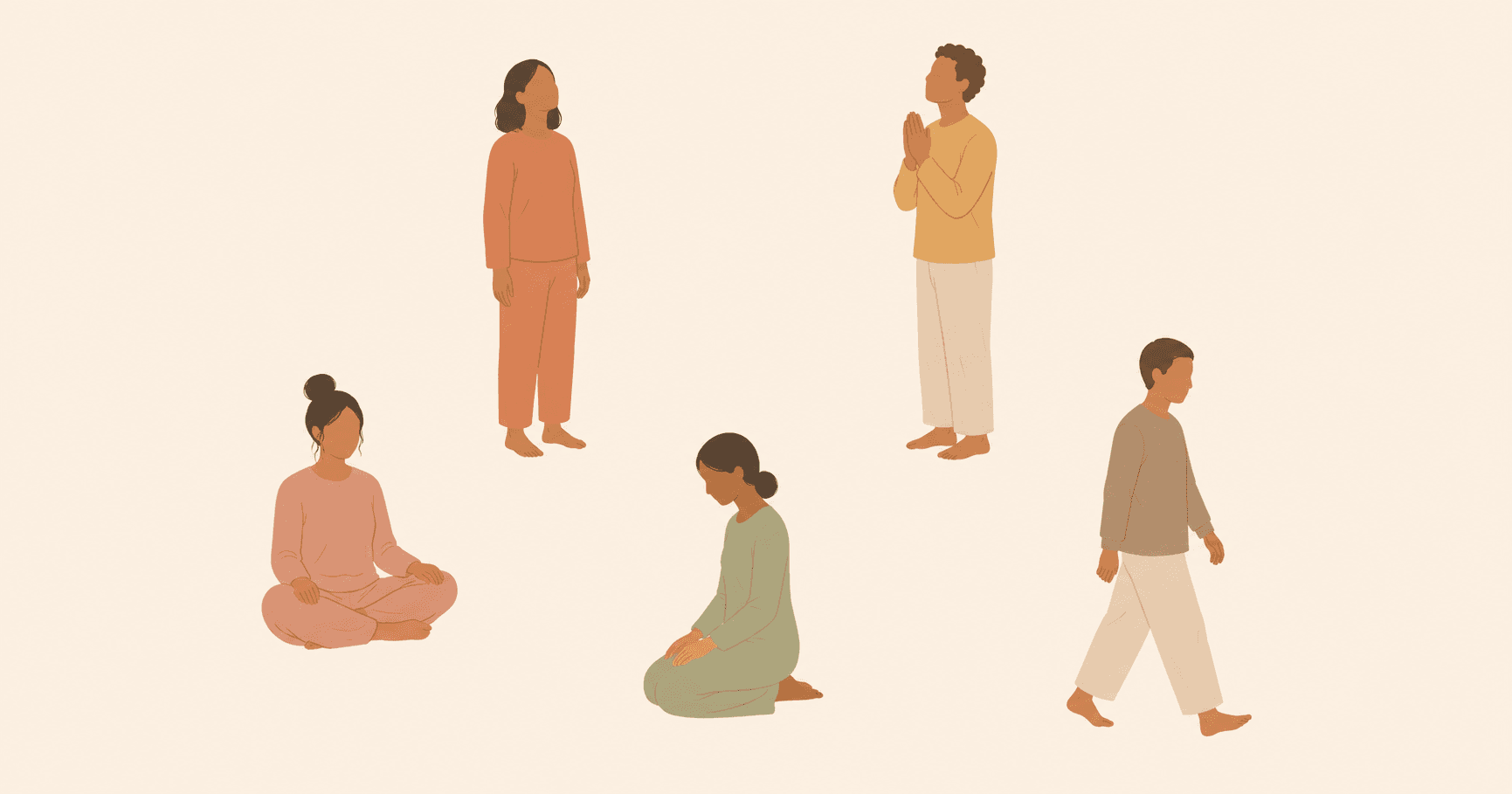
Every tradition in its own language, posture, and its own sacred rhythm has been trying to tell us the same thing. You are allowed to stop running. You are allowed to arrive right here, in this breath, in this moment, exactly as you are.
These are not just mindfulness tips or mindfulness techniques borrowed from a wellness trend. Each one is drawn from a tradition that has tested it across centuries. How to be more mindful is not really a question of technique but a question of willingness. Each of us is invited to find our own door into presence and to walk through it again and again for the rest of our days.
If mindfulness and its many mindfulness practice examples feel like a distant idea, you might find it useful to explore what human flourishing actually looks like when presence becomes a habit. You can also explore how to be happy through the Love, Learn, Play lens or see how goal setting through the Love, Learn, Play framework weaves mindfulness into everyday intention.