


Introduction
Try asking a child how to be happy, and they'll show you. For them, a puddle is an ocean, and a cardboard box is a castle. Somewhere between their imagination and adulthood, most of us start to believe that happiness lives further away: in the next raise, in the next relationship, in the next trip, and in the next milestone.
But it rarely does.
Three simple movements toward others, toward growth, and toward joy, rooted in wisdom traditions and UEF’s Love, Learn, Play philosophy, turn happiness from a chase to a practice. Happiness is not created from the outside but discovered from within. As we explore things to do for everlasting happiness, we shall unravel that real joy is built through practice, not luck and achievement.
What Does It Really Mean to Be Happy?

Before we talk about how to be happy, let us ask ourselves, what is happiness in the first place? There could be happiness in a good meal, a sunny afternoon, a joke that you share with a friend, and more. This pleasure is worth savoring, yet fleeting by nature.
Then there is something steadier. Greek philosopher Aristotle called it eudaimonia, which refers to a flourishing life or a life well lived. It is not the high of a good moment, but the quiet satisfaction of living in alignment with your values and potential. This happiness vs. joy distinction is one that so many people sense but struggle to name. Let us try to put it in words for you. Happiness can be circumstantial, but joy rises from within. It is totally independent of what the day brings.
In the yogic tradition, this steadier state is called 'Santosha,' or 'contentment.' The Santosha meaning is not resignation but the art of being at peace with what is while still growing towards what could be. It is entirely possible to be happy alone and in silence, without a single external thing changing.
Why Chasing Happiness Often Backfires

Enjoying this article?
Get UEF Insights. Writing on loving, learning, and playing, with insights from wisdom traditions and modern science delivered to your inbox.
Here is a quiet irony. The harder you chase happiness, the further it seems to run. Psychologists call it the hedonic treadmill. You buy the thing, you get the promotion, you reach the destination, and the glow starts to fade after a few days. And then you're back to asking, how can I be happy? If you've ever wondered why you are not happy despite doing everything right, the answer lies in this fact. External achievements were never built to hold the full weight of inner peace. In fact, UEF’s law of detachment speaks to this issue directly; peace grows not from acquiring more but from loosening your grip on outcomes altogether.
This little poem sums it up beautifully:
The river does not chase the sea
It simply flows and then lets it be
The flower never reaches for light
It opens and lets the sun find sight
So let the joy arrive in you
not chased, but grown in everything you do.
What the Wisdom Traditions Teach About Happiness

Across continents and centuries, happiness in different religions keeps returning to the same centre: what is already yours. These traditions may vary in language and ritual, but they mean that spiritual happiness is not to be found from the outside. The best of happiness is a state of untroubled wholeness.
- In the Hindu tradition, ananda is translated as bliss. It is supposed to be an essential characteristic of life, always present beneath the din of everyday life. The UEF exploration of the Hindu concept of bliss describes the state as something to be found, not made.
- Buddhism describes equanimity as a balance of mind that does not cling to pleasure nor fear pain.
- Stoicism, a philosophy that began in Greece and was perfected in Rome, teaches that happiness comes from controlling your reactions, not your conditions.
- Sufi poets spoke of happiness as something to be discovered not across the world but within oneself.
- Even Judeo-Christian teaching points inward. It describes the kingdom as something within, not as a place to travel toward.
The Habits of Happy People

You might wonder, if happiness is available to everyone, why do some people seem to live so much closer to it compared to others? So what is it that makes people happy?
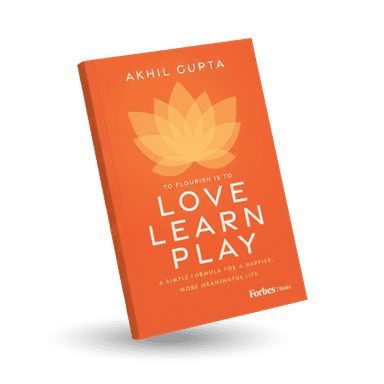
Love • Learn • Play
The formula for a meaningful life.
Research and tradition point to a similar set of happiness habits that are powerful enough to reshape your life over years.
• Gratitude
Naming three good things before sleep rewires attention toward abundance rather than lack, a practice as old as evening prayer and as current as modern psychology.
• Presence
Happy people are rarely thinking about yesterday or tomorrow while living today. They eat their meal while eating and walk their walk while walking.
• Connection
No study on well-being, ancient or modern, has ever found isolation to be a path to joy. Relationships remain the single strongest predictor of a happy life.
• Service
Giving, even in small ways, activates a kind of happiness that self-focused pursuit rarely reaches. It is one of the fastest ways to find happiness when it seems to have gone missing.
• Movement
The body and mind are not separate ledgers. A short walk, a stretch, and a dance in the kitchen all count.
Happiness Through Love, Learn, Play
UEF's own framework categorizes the ancient wisdom into three pillars that make it possible to practice at any age, starting today.
Love
No lasting happiness has ever grown in isolation. To love fully, whether a partner, a friend, a stranger, or oneself, is to open a channel that self-interest alone can never access. Learning how to be happy with yourself is, in many ways, the first and hardest act of love.
Learn
Happiness that never grows tends to grow stale. Curiosity keeps joy alive. To learn, continually, playfully, without the pressure of mastery, is to keep the mind supple and the spirit awake. Every new skill, every new question, every book finished, adds another thread to a life that feels genuinely lived.
Play
Somewhere along the way, many adults stopped playing and called it maturity. But play; real, unstructured, purposeless play, remains one of the most reliable keys to happiness available to anyone, at any age. It is happiness with nowhere to be, nothing to prove, and nothing to win.