
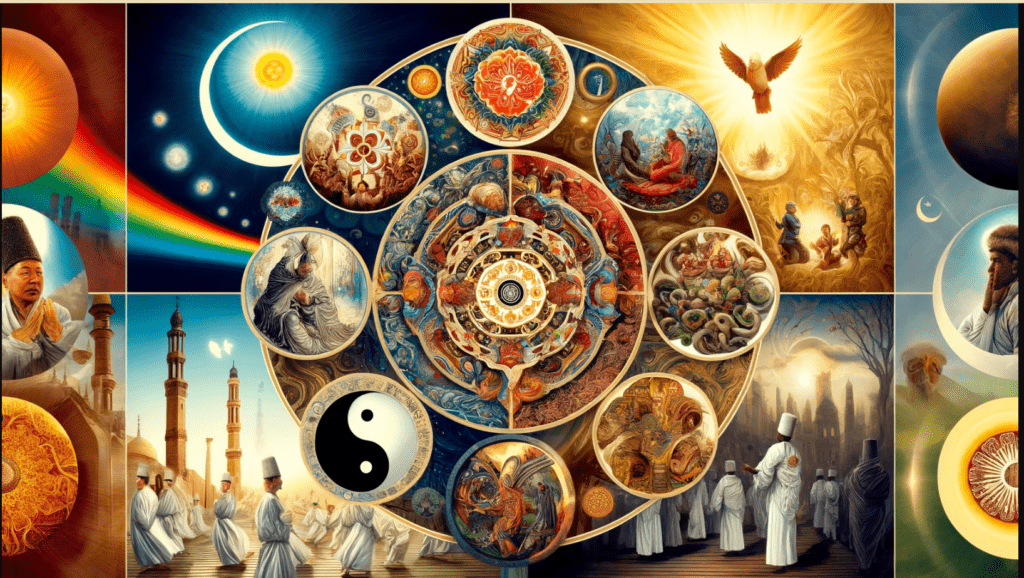
Circularity is a recurring theme in many religious traditions across the world. It represents the cyclical nature of existence, the interconnectedness of all things, and the eternal return of life, death, and rebirth.
Circular imagery is central to many mystical traditions, with the Mandala being a well-known example. Sufism, the mystical branch of Islam, incorporates circularity into its spiritual practices. The most iconic example of this is the Whirling Dervishes who spin in circles, symbolizing the cyclical journey of the soul in its pursuit of divine unity and enlightenment. The Yin-Yang symbol of Taoism, illustrates the interconnected and cyclical nature of the universe, consisting of two opposing and complementary halves, which represent dualistic aspects of reality.
At the heart of Hinduism and Buddhism is the concept of samsara, the cycle of birth, death, and rebirth. This cycle is often illustrated through the image of a wheel of existence, known as the Wheel of Dharma. Believers seek to live according to moral duty to acquire good karma and attain liberation (moksha or nirvana) from samsara (the cycle of birth and death). The Buddha’s Eightfold Path toward nirvana is also represented as a circular wheel.
The Christian belief in the redemption of sins through the crucifixion and resurrection of Jesus Christ reflects a cyclical process of repentance, forgiveness, and renewal. African traditional religions often incorporate circularity in their beliefs and practices. Ancestor worship, a common element in many ancient religious traditions– like traditional African religions, Japanese Shintoism, and Native American spirituality– revolves around the idea that the spirits of the deceased continue to influence the living.
Buddhism
“Samsara – our conditioned existence in the perpetual cycle of habitual tendencies and nirvana – genuine freedom from such an existence- are nothing but different manifestations of a basic continuum. So this continuity of consciousness is always present.”
– His Holiness The 14th Dalai Lama, Tibetan Buddhist leader
Hinduism
“O son of Kunti, the contact between the senses and the sense objects gives rise to fleeting perceptions of happiness and distress. These are non-permanent, and come and go like the winter and summer seasons.”
—The Bhagavad Gita (2:14), Hindu scripture
“In a religion like Hinduism, the cosmos is not created once. It is created over and over again, in an endless cycle of creation, preservation, and destruction. The cyclical life of the cosmos, moreover, mirrors the cyclical life of the soul. We might think of this as the Asian ‘circle model.’”
—Jeffrey J. Kripal, Historian of Religion
Baha’i
“At one time it is the season of spring; at another it is the season of autumn; and again it is the season of summer or the season of winter […] Such is, and such ought to be, the cycle and succession of existence. Such is the cycle and revolution of the material world.”
–‘Abdu’l-Bahá, Baha’i leader
Christianity
“Just as people are destined to die once, and after that to face judgment, so Christ was sacrificed once to take away the sins of many; and he will appear a second time, not to bear sin, but to bring salvation to those who are waiting for him.”
–The New Testament (Hebrews 9:27-28), Christian text
Judaism
“All creation is a rotating wheel, revolving and alternating. Everything goes in cycles. Man becomes angel, and angel, man. Head becomes foot, and foot head. All these things have a single root. All interchange, raising the low, lowering the high, spinning on the wheel of creation.”
—Tree of Souls: The Mythology of Judaism, collection of Jewish writings
Modern Psychology
“Religion restores, at regular intervals and through rituals significantly connected with the important crises of the life cycle and the turning points of the yearly cycle, a new sense of wholeness, of things rebound.”
—Erik H. Erikson, developmental psychologist
Taoism
“Birth and death are part of the natural cycle of things. Only those who can see through the illusions of life and death can be renewed with heaven and earth and age with the sun, moon, and stars.”
—Lieh-tzu, Taoist text