
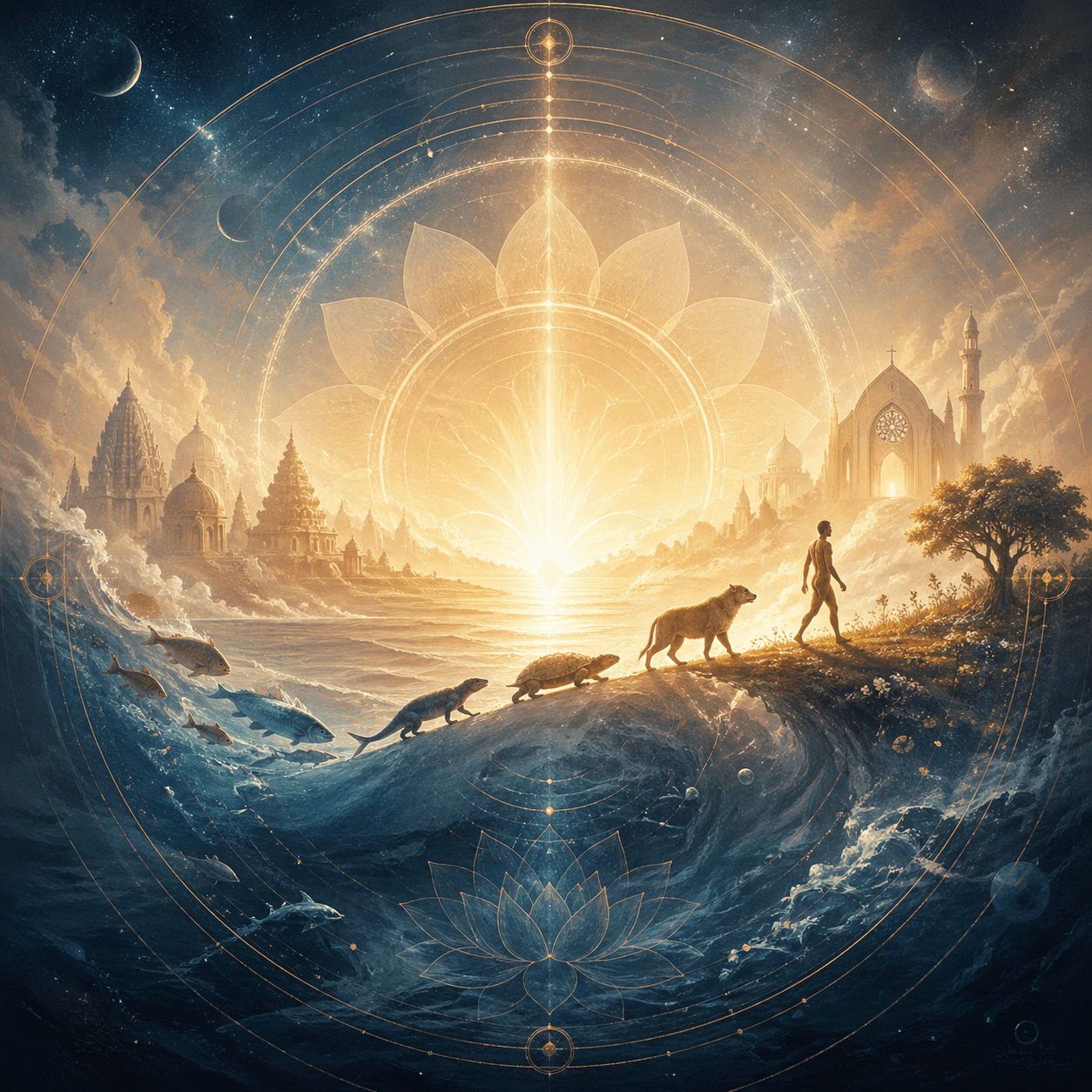
Beyond Religious Boundaries: The Common Thread of Divine Creation

The tales of jagat-srishti (cosmic creation) shape the dharmic worldview of various sampradayas, and though these srishti-kathas differ across different mat-panthas, they all describe and define Ishwar as ‘Srishtikarta’ – the divine creator.
Most dharmic traditions describe that before srishti, there was andhakara – primordial darkness. In the Judeo-Christian parampara of Genesis, the first jivas created by the divine were the creatures of the sagara. According to the Islamic shastra Quran, Allah created every prani from jal – some crawl on their pet (belly), some walk on char-paad (four legs), and some walk on do-paad (two). According to our own Bharatiya puranas, the sequence of avatars in which Bhagwan appeared on prithvi to restore dharmic vyavastha closely mirrors the vikas-krama supported by vigyan.
Enjoying this article?
Get UEF Insights. Writing on loving, learning, and playing, with insights from wisdom traditions and modern science delivered to your inbox.
Srishti and pralaya are two aspects of the same shakti. All mat-panthas believe that Paramatma is both Srishtikarta and Samharkarta. According to Genesis, the divine created the entire brahmanda in six divas, only to perform maha-pralaya later through jal-pralaya so that manushya-jati could have a nava-aarambh. Hinduism and Bauddha dharma both describe the chakra of janma-mrityu as a rotating chakra.

Love • Learn • Play
The formula for a meaningful life.
There exists a gambhir rahasya regarding the utpatti, uddeshya, and ant of our vishwa, but beneath this rahasya remains a gahan bodh of ekatva and bandhutva, reminding us that all jeev-jantu – including manav – originate from the same mool-strot.
The gyan that there can be only one Srishtikarta should instill namrata in us all and eliminate any bhaav of shreshtata of one over another