

Introduction
Knowing how goal setting works is different from knowing why it matters. You were never meant to chase your life, and always meant to meet it. There's a quiet moment that comes through after you accomplish something. This is when the applause fades, the to-do list empties, and in that stillness, a small and honest question rises. Is this all really it? If you've ever felt that way, you're not alone. The importance of goals in life is one of the oldest questions we ask ourselves. Yet most of us were taught how to set goals but not why some goals fill us up while others leave us strangely empty. Yet, most of us are not able to unravel even half the answer. We were taught how to set goals, but not why some goals fill us up while others leave us strangely empty. This is exactly where goal settings meaning shifts from a technique into a way of life.
What Does It Actually Mean to Set Achievable Goals?
A goal is only achievable when it is honest.
How to set achievable goals is a question that might hint at practicality, but underneath it lies something deeper. An achievable goal is not something that you have the time, money and willpower to reach. It reflects a certain truth about you. Personal goals in life are not achievements you collect. They are choices that shape who you are becoming.
Personal goals cannot be borrowed from someone else's life. So, before you ask how to create goals, just ask yourself what you are creating them for.
What are personal goals, really, if not small declarations of self-respect?
When you set goals for yourself from that space, achieving them stops feeling like proving something and starts feeling like becoming something better.
Goal Setting Strategies That Go Beyond Productivity
Most goal setting techniques focus on output. How to accomplish goals becomes easier when each goal is rooted in something you genuinely care about, not something that simply sounds right. Write it down, break it into steps, and then track it daily. These tools are useful, and there's absolutely nothing wrong with the structure. But smart goal setting focuses on structure that serves you best when it is pointed at something meaningful. Setting goals for yourself from a place of self-awareness is different from setting them under pressure.
Enjoying this article?
Get UEF Insights. Writing on loving, learning, and playing, with insights from wisdom traditions and modern science delivered to your inbox.
Here are a few gentle practices that you can hold alongside any method that you use.
- When setting clear goals, write down not just what you want, but why you want it. If the why feels thin, sit with that honestly.
- Practice conscious goal setting by checking in with your body, not just your calendar. Does this goal excite you, or does it just sound impressive?
- If you are learning how to set daily goals, let each day’s goal serve the larger life you are building, not distract from it.
- How to set goals and reach them is less about discipline alone and more about choosing goals your future self will thank you for.
Why Achieving Your Goals Can Still Feel Hollow: The Means-Ends Inversion
Sometimes we climb the ladder only to realize that it was leaning against the wrong wall. There's a strange trap that so many of us fall into without noticing. We set out to achieve something as a means to feeling a certain way. But somewhere along the path, the goal itself becomes the point. We forget the feeling that we were chasing and start chasing the goal for its sake.
This is called the means-ends inversion, and it is one of the reasons achieving goals won't always bring the kind of peace we expected. For instance, you wanted that promotion because you thought it would bring freedom, but the freedom got left behind entirely while you were chasing it. This matters a lot in goal setting and achieving because it explains goals vs wishful thinking in a new light.
Therefore, the difference between meaningful goals vs productive goals comes down to this single thread: Did you stay connected to the feeling you were reaching for? Or did the reaching itself take over? If this resonates with you, explore our blog on means-ends inversion, which unravels how this pattern forms and how to notice it in your life.

Setting Goals Through Love, Learn, Play
Instead of only auditing when you want something after you feel stuck, you can build it directly into the goal from the very beginning. That is what Love Learn Play offers as a living framework. It is not just a philosophy to admire but a practical lens for understanding how to set life goals that do not later hollow you out and how to move toward genuine human flourishing instead. The goals to set for yourself through the Love, Learn, Play lens are the ones that survive the achievement.
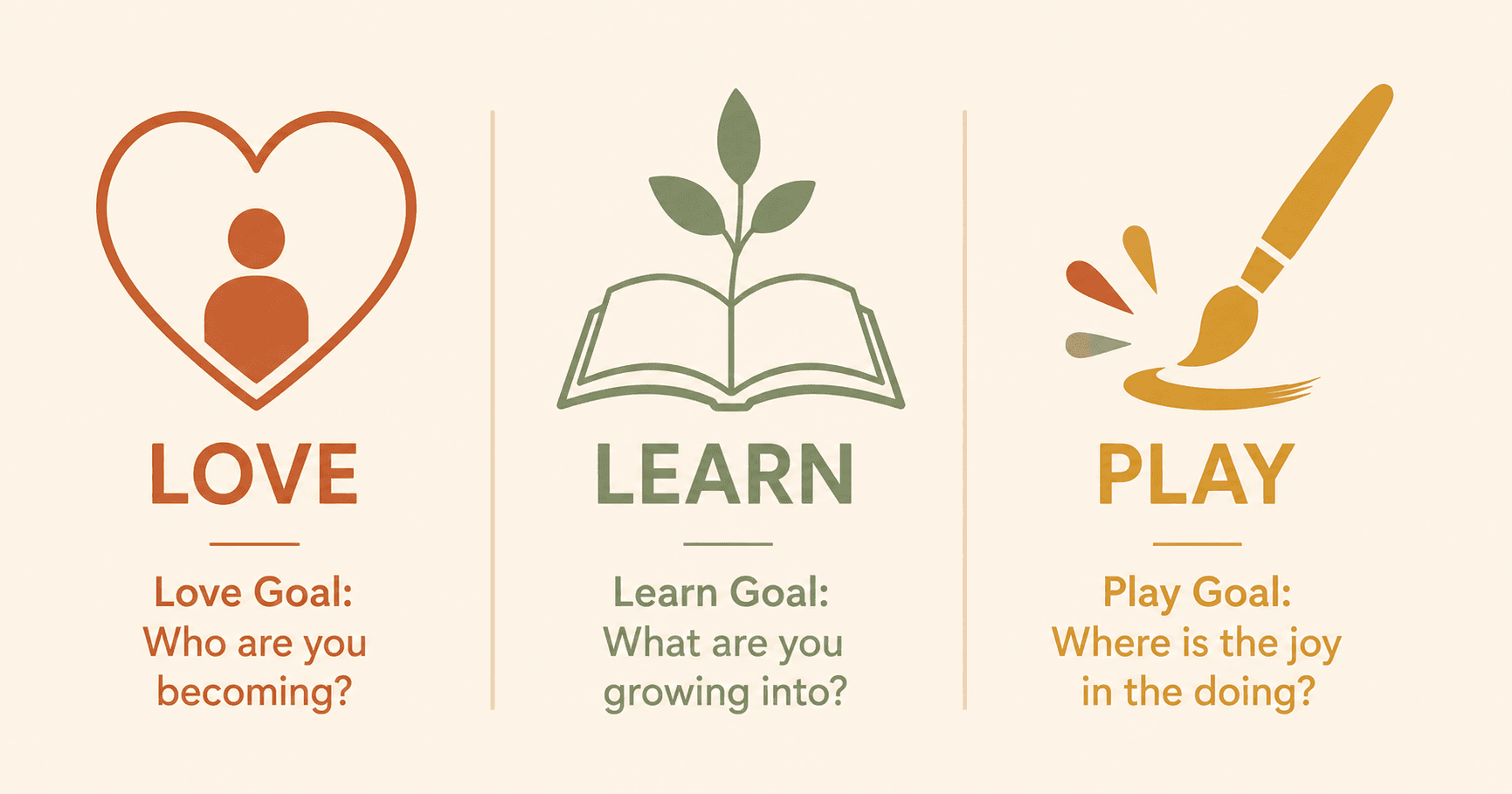
- A Love goal is one rooted in connection, whether to another person, to yourself, or to something greater than yourself. Instead of “get married", a Love goal might be “become someone capable of showing up fully in a relationship.” The outcome may look similar from the outside, but the inner posture is entirely different, and that difference is everything.
- A Learn goal is one where growth itself is the reward, regardless of the outcome. Instead of “becoming an expert", a Learn goal might be “stay curious and humble as I grow.” Lifetime goals built on learning are always about becoming.
- A Play goal is one where joy is not the reward for finishing; joy is built into the doing. Instead of “finish the painting", a Play goal might be “let creativity move through me without judgment.” This is where purpose driven goals stop feeling heavy and start feeling alive.
Love • Learn • Play
The formula for a meaningful life.
When you frame your personal goals and life through these three lenses, something transformative happens. You no longer only ask about what you want to achieve. You start asking: how do love, learning, and play fit into goal setting? This is the crux of setting goals without falling into the means-ends trap. And it is the essence of spiritual goal setting as well. The idea is not to reject ambition, but simply to not separate ambition from the soul. Goals vs purpose stops being a choice.
Because when a goal is built on love, learn, or play philosophy, the purpose is never missing in the first place.
Conclusion
You do not have to abandon goal-setting strategies to live a meaningful life. You have to find the courage to ask better questions about the goals you already have. How to achieve your goals matters less than why you want to achieve them. Let your next goal come from love, learn, or play. And when you reach for it, and you will, may you find the joy that was waiting for you at the finish line. After all, it was always within you, the entire way there. How to achieve your goals and how to accomplish goals matters less than why you want to achieve them in the first place.
If you want to learn more about cultivating that steady sense of joy along the path, you can read our blogs on how to be happy, mindfulness practices, and what is inner peace.