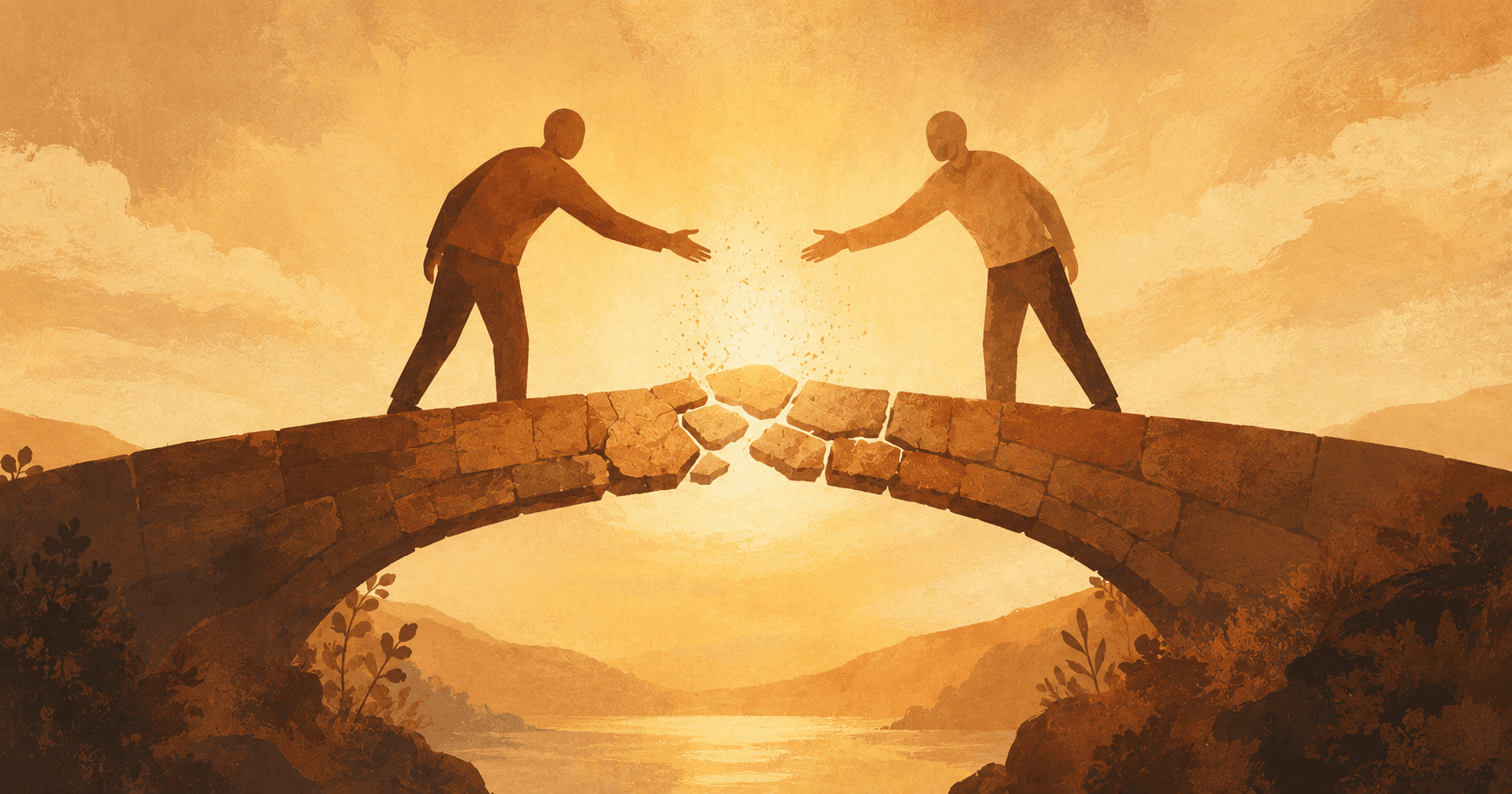


When we mention the word “Forgiveness,” what comes to mind? Someone you have forgiven or someone you can’t forgive? At UEF and the Human Flourishing Program at Harvard University, we believe the answer to this question may reveal your path to flourishing.
To this day, contemporary philosophers and leaders like Charles Taliaferro and Pope Leo remain committed to forgiveness through love. In the Christian tradition, the Gospel writer Matthew 6:14 frames it as something we extend to others and receive in return. Forgiveness in religion is never just a personal feeling. It carries consequences for the whole community.
Differing traditions may emphasize competing components of forgiveness, but they all confront the same human dilemma: After someone wounds us, how do we keep that wound from deciding who we are and who we become?
UEF has explored the religious dimensions of this question in The Cycle of Forgiveness and Repentance in Religious Traditions. Now, the Global Forgiveness Movement at the Human Flourishing Program at Harvard University is bringing scientific research and practical tools to the same ancient problem.
The Human Flourishing Program believes forgiveness requires a simple demand: forgiveness means replacing ill will toward someone who harmed us with goodwill toward them.
Why is that so difficult?
Anger tells us that a boundary was crossed. Fear warns us against being hurt again. The desire for justice affirms that the injury mattered. Resentment, which is that persistent re-experiencing of a past wrong, may grow and crystalize over time.
These responses can imprison us over time. The offender may leave while the argument continues inside us. A name, place, or memory can return us to the injury. Rumination consumes attention. The past begins to organize new relationships and choices. Findings support an insight that wisdom traditions have long taught: sustained ill will can injure the person who carries it. It can melt us from the inside. Perpetual ill will destroys its host, and forgiveness gives us a way out. Understanding how to let go of resentment begins with recognising that it started as something reasonable. It becomes a problem when it outlasts its usefulness and starts costing us more than it costs the person who caused the harm.
The benefits of forgiveness go beyond the moral and spiritual. The connection between forgiveness and mental health is one of the most consistent findings in psychological research. The Human Flourishing Program helped test a self-directed forgiveness workbook in a randomized trial involving more than 4,500 participants in Colombia, South Africa, Ukraine, Indonesia, and Hong Kong. Compared with the control group, participants who completed the workbook reported greater forgiveness, hope, and flourishing, along with lower symptoms of anxiety and depression.
Forgiving is healthy, but it is not merely a health strategy. It remains a moral, relational, and often spiritual act. Given the complexity of the path toward forgiveness simple destination, it’s worth exploring the resources ready-made for us. For example, in a brief and illuminating video, the Human Flourishing Program expands and clarifies their results. Yet it may not be enough to demonstrate the profound value of forgiving if we have no practical path to develop our capacity to forgive.
Harvard’s recommended practical path: The REACH method
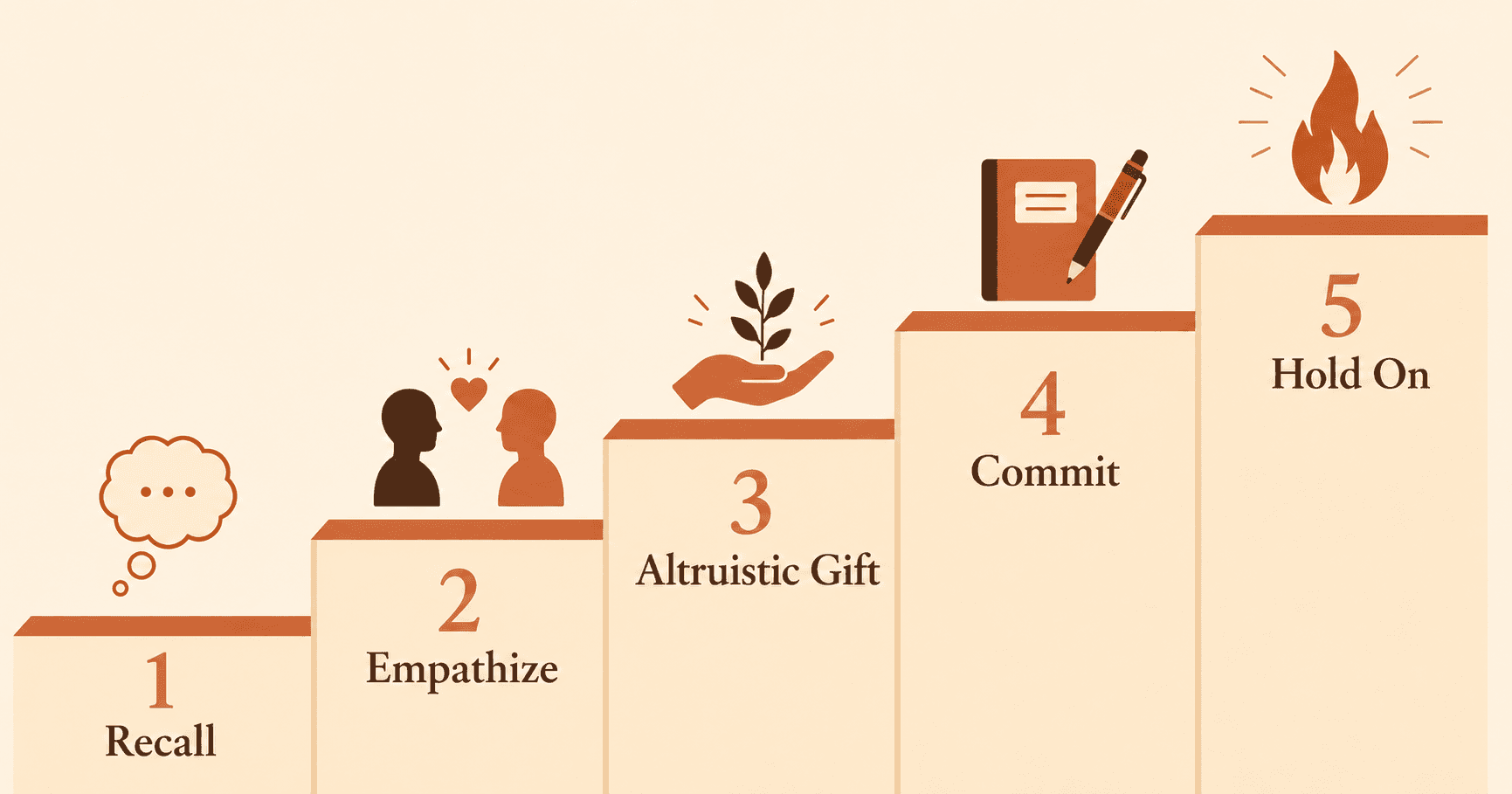
Psychologist Everett Worthington developed the REACH model to turn forgiveness from an abstract ideal into a way to practice forgiveness one step at a time. You do not need to feel ready. You just need to begin. The free REACH Forgiveness Workbook guides readers through five steps that are designed to be a practical curriculum toward being able to forgive. Like all capacities, it can be developed. In this case, our capacity to forgive relies on recalling the hurt, empathising with the offender, offering an altruistic gift, and a long-term commitment to hold onto that forgiveness
Enjoying this article?
Get UEF Insights. Writing on loving, learning, and playing, with insights from wisdom traditions and modern science delivered to your inbox.
What is the REACH method of forgiveness? It is a five-step framework developed by psychologist Everett Worthington that turns forgiveness from an intention into a practice.
R- Recall the hurt
Return to what happened. Name the offense, the emotions attached, and the meaning it carries for you.
E - Empathize with the offender
Try to understand why the offender wronged you, without feeling obliged to justify it.
A - Offer the altruistic gift of forgiveness
Remember a time you have received the gift of forgiveness as a reminder of our common humanity, and acknowledge that forgiving the offender would be a gift.
C - Commit to forgive
Write it down. Mark it in a journal. Tell a trusted person. Create a private ritual or reminder.
H - Hold on to forgiveness
Return to the earlier steps and walk through them.
All of these steps reflect profound inner work, and the process of learning how to forgive can be enhanced by relying on what we at UEF believe to be our three deepest longings along the way: to Love, to Learn, and to Play. Forgiveness engages all three.
Love
Love and forgiveness are so closely bound in wisdom traditions that it is almost impossible to describe one without the other. In asking ourselves to forgive others, we are asking ourselves to embrace a certain kind of love: beneficent love is when you want the best for someone whether or not you are with or around them. Unitive love is where you want to be with someone, whether or not it is the best for them. Sometimes, beneficent love encourages us to want to see someone recover from various addictions and harmful behaviors and to keep a distance from people or places that might trigger them into immorality.
Forgiveness expresses love when it refuses to reduce a human being to the worst thing that person has done. The offender remains responsible for the offense. Yet the offense does not exhaust the offender’s humanity or our good will towards them. Love requires a broad vision, one with a more complete portrait of someone’s humanity, one that absorbs the dank pain of revenge and turns it into the compassionate gaze of forgiveness.
Certain wounds also make it harder to love ourselves, to believe that we too deserve relief from the stubborn pain of longing for revenge. We liberate ourselves from ourselves through forgiveness, a form of release from the grips of a devouring darkness. As Reinhold Niebuhr wrote, "We must be saved by that final form of love, forgiveness."
Learn
We must learn in order to forgive, and to be forgiven.
The forgiver must learn how to forgive practically, morally, and emotionally. The REACH strategy of Harvard offers extraordinary guidance on the mechanics and pathways towards forgiveness. Yet the emotional and moral components of forgiveness demand of us to learn how to transcend our instinct for revenge. We must learn how to unlearn what epochs of evolution have instilled within us. Some call this radical forgiveness. Not because the harm was small or excusable, but because the choice to release it is so contrary to what instinct demands. The philosopher Nagasawi argues that this kind of transcendent rebellion against corrosive or immoral impulses is nothing shy of a miracle in motion. Like many things, forgiveness is a practice. Harvard recommends learning how to forgive by practicing it with a smaller hurt. Not the most traumatic element of your life, but something that matters enough for you to acquire the ability to forgive through it.
For the forgiven, they must learn how to change, how to transform themselves for the better. Growth comes from learning.
You might ask why it’s important to emphasize the role of learning for both the forgiver and the forgiven. The reason is simple: sometimes we are both the forgiver and the forgiven, and sometimes we must also learn how to forgive ourselves. Self forgiveness is often the hardest kind because the voice making the case against you is your own. As Ibn Arabi wrote “I am both the lover and the beloved, the knight and the maiden.” Sometimes we offer forgiveness, and other times we accept it. We are all on this journey through life together, for better or worse, and learning how to love through forgiveness will make our relations to others and ourselves flourish.
Play
Play is not only a capacity we acquire once forgiveness has taken place. It is an ability that shapes our very capacity to forgive. Play can give us reflective distance from the injury, it can reset our emotions, and most importantly, it can remind us that we are all human.
Love • Learn • Play
The formula for a meaningful life.
In the process of playing, we let go of the past and future. Time dissolves. We become so absorbed by the moment that we let go of our need to recycle the same negative story or vengeful aims in our hearts.
Through the imagination, a form of serious play can help us forgive. As Huizinga wrote in Homo Ludens “imagination bridges the gap between idea and being.” It is precisely the sympathetic imagination, and the ability to imagine another way forward which allows us to forgive and resume a life of love, learning, and playing.
Of course, to this point we’ve described the solitary path towards forgiveness and flourishing. But you are not alone.
Community
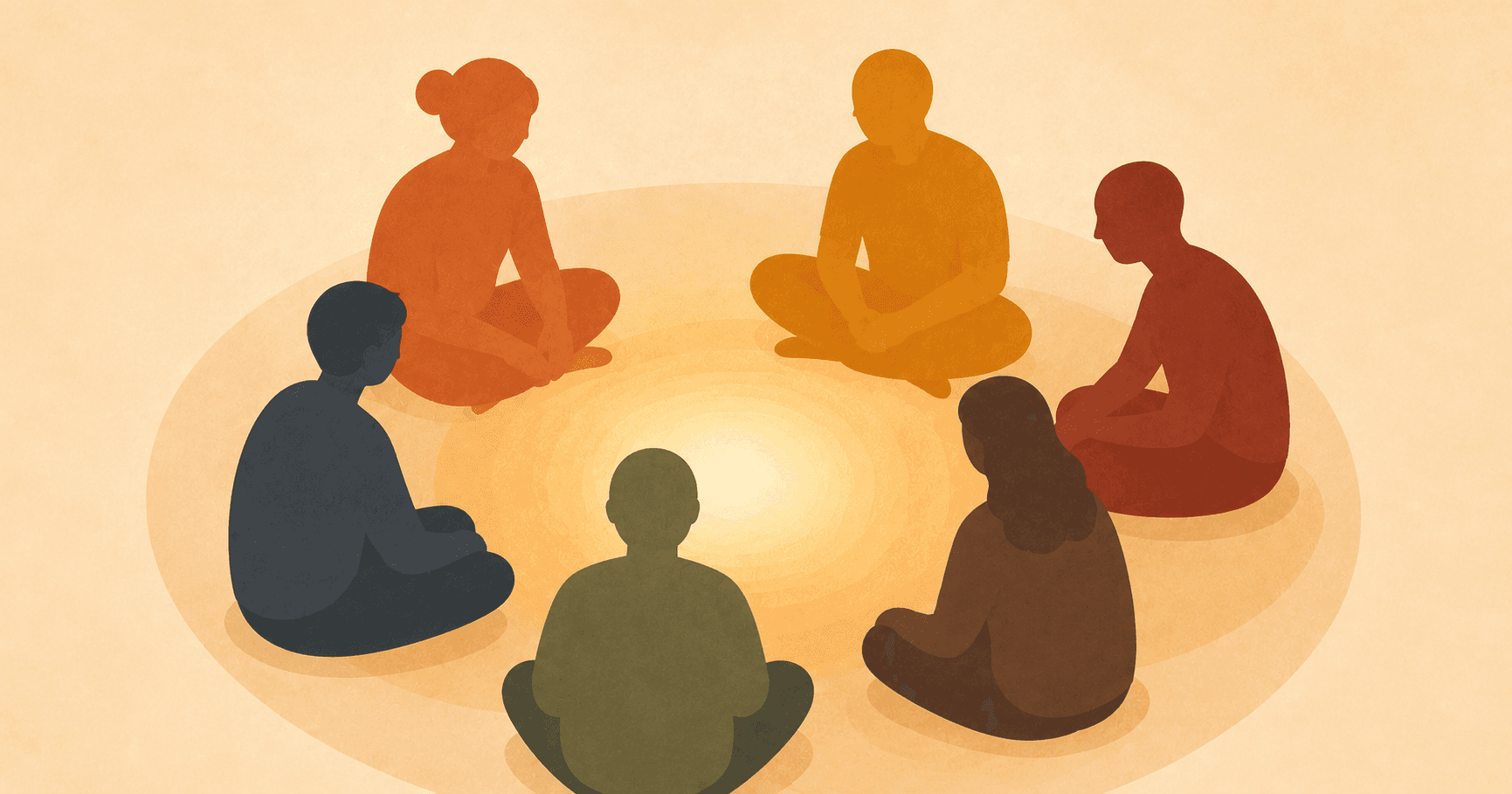
We may find it hard to navigate forgiveness alone. Community can be a vital part of our path to forgiveness. The poet John Donne wrote that “no man is an island.” We love, learn, and play in communities. The same mindfulness practices across wisdom traditions that help individuals process injury also find expression in communal rituals of repair.
Harvard has developed the concept of a Forgiveness Group composed of six to ten people who meet at least three times to learn, discuss, and encourage each other while working through the REACH handbook. Harvard has a video detailing how you can do this with others here: Forgiveness Groups video.
Communities can also draw from Harvard’s Community-Wide Forgiveness Activity Book. It includes rituals, reflection exercises, group activities, and resources for introducing forgiveness to adults and children.
Can you forgive without reconciling? Yes. Forgiveness and reconciliation are not the same thing. You can release ill will toward someone while choosing not to restore the relationship. Some relationships should not be restored. Forgiveness and healing can happen even without the other person in the room.
This communal dimension matters. Harm occurs within families, workplaces, religious communities, institutions, and societies. Healing cannot always be reduced to an adjustment inside the person who was hurt.
A healthy community makes room for truth, protects confidentiality, respects choice, supports accountability, and refuses to use forgiveness to silence unresolved injury.
Whether you take the road alone or lean into the support of a community, we hope this article and its resources move you closer to human flourishing. Remember, as the research shows, we can forgive another and be the one who benefits the most from altruistic action. Love, be loved: forgive, be forgiven. Join the global forgiveness movement and set yourself free.
Take the next step with Harvard’s Global Forgiveness Movement
- Explore the Global Forgiveness Movement and its current research and resources.
- Download the free REACH Forgiveness Workbook.
- Watch Research on Forgiveness and Forgiveness Groups.
- Join Harvard’s Forgiveness Network to receive news about programs and resources.
- Register for the Forgiveness Community of Practice to learn with researchers and others working to spread forgiveness.
- Use the Community-Wide Forgiveness Activity Book to begin a conversation or activity in your own community.