
Lesson
Apophatic Language
Have you ever stood beneath a star-studded sky, overwhelmed by its vastness and the mysteries it holds? That sense of awe, the feeling that words fall short in capturing the immensity of the experienc

Author

Akhil Gupta is the founder and director of Universal Enlightenment Forum
Akhil Gupta is the founder and director of Universal Enlightenment Forum, a 501(c)3 corporation. He has been associated with Harvard University since 2015, first as a fellow at Advanced Leadership Initiative and later as an Impact Leader in residence in 2023. Akhil currently serves on The Dean’s Leadership Council at Harvard Divinity School, on the Advisory Board of Harvard’s Human Flourishing Program, and on the Advisory Board of Harvard’s Chan Initiative on Health and Homelessness.
He is the author of two books “Bridges Across Humanity” published in 2023 and “To Flourish is To Love Learn Play” published in December 2025.He was inspired to write these books while studying at Harvard University.
Prior to Harvard, he was the founder Chairman of Blackstone India & Senior Managing Director of The Blackstone Group. He also served in senior positions at Reliance Industries Limited and Hindustan Unilever
Akhil has a B.Tech from Indian Institute of Technology and an MBA from Graduate School of Business, Stanford University. He served on the Advisory Council of the Graduate School of Business at Stanford University from 2014 to 2021.
235 pieces
Lesson
Have you ever stood beneath a star-studded sky, overwhelmed by its vastness and the mysteries it holds? That sense of awe, the feeling that words fall short in capturing the immensity of the experienc

Blog
Samsara, Yin-Yang, Whirling Dervishes, resurrection -- circular time appears in every tradition. The cycle is not a trap but a path toward liberation.

Lesson
In this lesson we cover praise as a universal expression across faiths. The Christian "Praise the Lord" mirrors Islam's "Alhamdulillah," Judaism's Shema, Sikhism's "Waheguru," and Hinduism's Gayatri Mantra. Each tradition expresses reverence, gratitude, and awe for the divine through distinct yet unified gestures of devotion.

Lesson
Joseph Campbell, the popular writer about comparative religion and mythology, once argued that bliss is at the universal core of religion.

Blog
Family is where we first learn to love. Across religions -- from Confucius to the Baha'i faith -- family unity is the prerequisite for community.

Blog
Noah, Gilgamesh, Matsya, Deucalion -- flood stories appear in nearly every culture with identical elements. Coincidence or shared memory?
Lesson
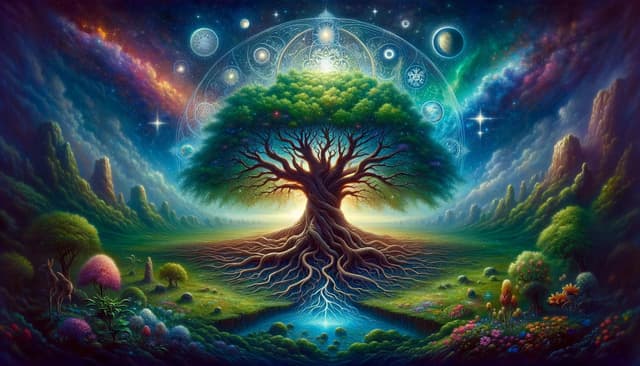
Cosmic Tree: The Tree Of Life And Knowledge

Lesson
Circularity is a recurring theme in many religious traditions across the world. It represents the cyclical nature of existence, the interconnectedness of all things, and the eternal return of life.

Blog
Jesus and Krishna never met, yet their ethical teachings converge on duty, selfless action, and inner transformation. The parallels are striking.

Blog
From Abraham's test to Buddhist detachment, sacrifice means surrendering ego, not just making offerings. Every tradition agrees on this evolution.

Blog
Eight major religions, one message: oneness. Scriptural quotes from each tradition prove the ethical foundation is shared, not separate.

Lesson
Many traditions believe God governs justice and calls humans to uphold divine law. We draw on the Qur'an's command to justice, the Bhagavad Gita's teaching on dharma and incarnation to restore righteousness, Buddhism's path to cease evil and do good, and karma across Hindu and Buddhist cosmology.

Blog
Sibling rivalry runs through ancient myths and sacred texts, revealing timeless lessons about jealousy, responsibility, forgiveness, and peace.

Lesson
In this lesson we cover the two selves: a higher self and a lower self, present across all religious traditions. The goal of human life is transcending the lower self and abiding in the higher self. We draw on Christianity's spiritual body, Judaism's soul, Taoism's balanced mind and body training, Islam's Qur'an, and Hinduism's law of duality.
Lesson
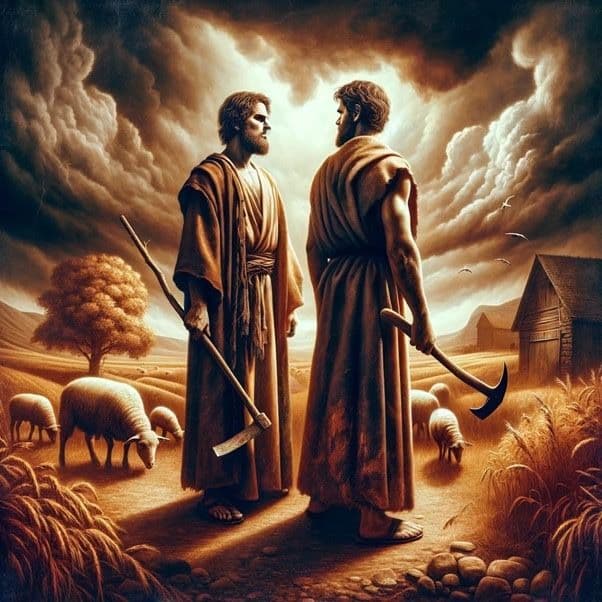
Sibling rivalry is a universal theme across traditions. Jealousy, greed, and pride among family members teach moral lessons about forgiveness and compassion. We draw on Cain and Abel from the Hebrew Bible, the Ramayana's conflict between brothers, and ancient Greek tragedy's exploration of fraternal conflict.

Lesson
Human existence encompasses more than the physical realm. Many world religions acknowledge the presence of non-physical dimensions within human beings, such as the soul, higher consciousness, and spir

Lesson
In this course we cover the teachings of Christ and Krishna. Both figures emphasize love, compassion, and service as pathways to spiritual realization. We draw on Krishna's Bhagavad Gita teaching of selfless action and duty, his relationships with Radha and the Gopis symbolizing divine love, Christ's Sermon on the Mount and emphasis on forgiveness, and their shared call to serve the welfare of others.
Lesson
In this course we cover the striking parallels between Jesus Christ and Krishna. Both are divine incarnations born miraculously, both symbolized as shepherds guiding their flocks, both embodied sacrificial love and rose after death. We draw on the Gospels of Matthew and John, the Bhagavad Gita, the Hindu Mahabharata epic, Father Francis Clooney's comparative theology, and the shared universal archetype of the divine teacher-savior.
Lesson
In this course we cover the parallels between Christian Lent and Hindu teaching. Both traditions offer a 40-day period of spiritual transformation: Christians through fasting and prayer following Jesus' desert ordeal, Hindus through Krishna's teachings to Arjuna on duty and divine wisdom. We draw on the Bhagavad Gita, the Gospels of Matthew and Mark, Father Francis Clooney's comparative theology, and the shared theme of overcoming human limitation through spiritual practice.
Lesson
In this course we explore interfaith dialogue through the work of Father Francis X. Clooney, Jesuit priest and Harvard Divinity professor. His study of Hinduism deepened his Christianity, showing how traditions enrich one another. We draw on his courses on the Bhagavad Gita, the Upanishads, Patanjali Yoga, and the striking parallels between Krishna and Christ.

Lesson
Seeking Union with God Across Traditions

Lesson
In this course we cover diversity as nature's design enabling human flourishing and progress. Eight million species reflect God's creative abundance. We draw on the Quran's celebration of languages and colors as divine signs, Hinduism's infinite adaptability, Ubuntu's principle of shared humanity, and the LLP mindset's expansion of love and learning across all difference.

Lesson
In this course we cover interconnectedness as the foundation of human flourishing. We draw on Vasudhaiva Kutumbakam (the Sanskrit principle that the world is one family), Hindu Upanishadic teachings on seeing all beings as oneself, the Qur'an's emphasis that all humans share a single origin, and systems theory in modern physics and ecology.

Lesson
In this course we cover means and ends inversion, the confusion of goals that marks our age. We examine how institutions and individuals drift from their ultimate ends through false narratives and cognitive bias. We draw on Einstein's wisdom, the LLP framework, and Jungian psychology to recalibrate why we act.