


Introduction
Long before anyone printed a date on a calendar, humanity had already decided that friendship is going to be celebrated.
International Day of Friendship falls on 30th July, a day that the United Nations has set aside so the world could pause on only something we often take for granted. Friendship Day itself is a fairly modern idea born out of greeting cards and good intentions. But the concept it celebrates is very ancient.
The Roman statesman Cicero once said that taking friendship out of life was like taking the sun out of the world. And, long before greeting cards got involved, the Bible, Aristotle, the Buddha, the Quran, and the Bhagavad Gita were already treating friendship as one of life's most sacred bonds. Every major wisdom tradition seems to be circling the same truth that a real friend changes the shape of your life. Take a look at what the world's oldest traditions have to say about it and what they can teach us about building friendships that last.
What Makes a Good Friend, According to the World's Oldest Traditions
If you were to ask a monk, a rabbi, a philosopher, or a Sufi mystic what makes a good friend, you will probably hear the same answer wearing different clothes.
Across different scriptures, philosophies, and folklore, the same handful of qualities keep showing up. A good friend is someone who's loyal even when loyalty is inconvenient. He or she is honest, including about those things that you do not want to hear. A good friend will help you grow instead of keeping you comfortable, and he or she gives without keeping score.
The Bible calls this steady and unconditional loyalty. Aristotle called it virtue. The Buddha called it Kalyanamitta, which is a spiritual friend who walks beside you on the path rather than just alongside your life. Confucius had built an entire ethical outlook on the idea that a friend tells you the truth to your face rather than behind your back. This is the heart of what makes a good friend according to religion, almost everywhere you look. It's not just about how fun someone is, but whether they make you more honest, more whole, and more yourself.
- If a friendship survives seven years, it tends to last a lifetime.
- What others whisper behind your back, a true friend will say to your face.
- A real friend is often all the therapy you need.
- You do not need to spend the most time with someone, only the best time.
- A real friend makes your problems their own, so you never have to carry them alone.
- A true friend is a treasure you choose for yourself.
"The only way to have a friend is to be one." — Ralph Waldo Emerson

Enjoying this article?
Get UEF Insights. Writing on loving, learning, and playing, with insights from wisdom traditions and modern science delivered to your inbox.
What the Bible and Judeo-Christian Tradition Say About Friendship
The Bible does not treat friendship as small talk.
The book of Proverbs describes a friend who loves at all times, someone who sticks closer than a brother. Ecclesiastes goes further, saying that two are better than one, because if either falls, the other can help them up. This is friendship in the Bible at its most practical, where it is not about sentiment, but support. Why is friendship considered sacred in this tradition? Because it mirrors the same kind of steady, unbreakable commitment that Judeo-Christian tradition used to describe the bond between people and the divine. The friendship between David and Jonathan is the clearest picture of loyalty in action. Jonathan was a king's son, and he loved David as his own soul and stood by him, even when it cost him his inheritance.
It could almost be a footnote to the Book of Ruth, where Ruth refuses to leave her mother-in-law Naomi, choosing loyalty over comfort and a familiar home. In Judeo-Christian tradition, this kind of loyalty is not just admirable but holy.
Aristotle, the Stoics, and the Different Types of Friendship
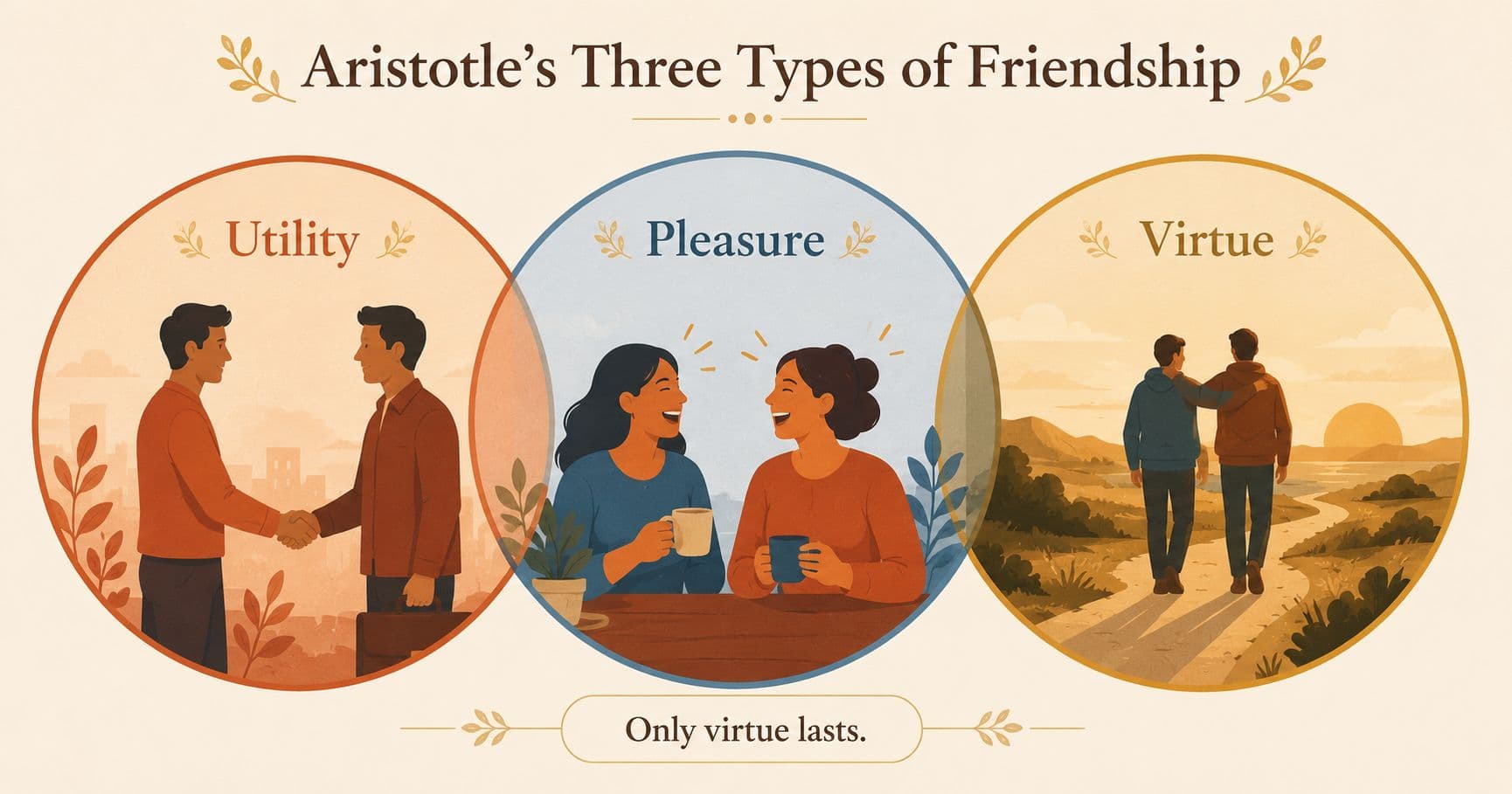
What did Aristotle say about friendship? His answer, laid out in the Nicomachean Ethics, was that a friend is a single soul dwelling in two bodies. Aristotle spent an entire book of the Nicomachean Ethics trying to answer one question. What is a friend? His answer still holds up today. Aristotle's friendship theory describes it as a single soul dwelling in two bodies, a bond so close that the line between self and other starts to blur. But he was also precise about the fact that not all friendships are built the same way. So, what are the three types of friendship according to Aristotle?
- Friendships of utility are based on what two people can do for each other, like colleagues or business partners.
- Friendships of pleasure are based on enjoying someone's company, their humor, or their energy.
- Friendships of virtue, what Aristotle called perfect friendships, are built on mutual respect and shared goodness, pursued for their own sake, rather than for any benefit of all.
Of the three types of friendship, only virtue is built to last.
Modern research backs this claim unequivocally. One widely cited study found that friendship accounts for nearly 60% of the difference in happiness between individuals, irrespective of the fact whether they are introverts or extroverts. Friendship and happiness, as it turns out, are almost inseparable.
What Buddhism, Islam, and Hindu Tradition Say About Friendship
Once you travel east, the sacredness of friendship only grows deeper.
- What does Buddhism say about friendship? The answer centres on the concept of kalyāṇa mittā, or spiritual friend. A kalyāṇa mittā, or spiritual friend, is considered very important for walking any meaningful path. Buddha reportedly told his attendant Ananda that good spiritual friendship is not just half of a holy life but whole of it. That is because people around us shape who we become. Friendship is treated as a form of compassion in motion, where one person helps another move closer to peace.
- Friendship in Islam carries a similar meaning. A well-known hadith compares a good companion to a seller of musk, someone whose company leaves you better simply for being near them. The friendship between the Prophet Muhammad and Abu Bakr is often held up as a model of loyalty, trust, and steadfastness through hardship.
- In Hindu tradition, the story of Krishna and Sudama is one of the most loved friendship stories of all. Sudama, poor and humble, visits his childhood friend Krishna, who is now a king, unsure of how he will be received. Krishna welcomed him with open arms and genuine joy, showing that true friendship does not bend to status or circumstance. The Bhagavad Gita describes "sakha," or friend, as one of the ways the divine chooses to relate to us.

Love • Learn • Play
The formula for a meaningful life.
Why Ancient Traditions Say Friendship Is Essential to Human Flourishing
"Think where man's glory begins and ends, and say my glory was I had such friends." — W. B. Yeats
None of the traditions treat friendship as decoration on top of a good life. They treat it as one of the load-bearing walls. This is what ancient traditions mean when they connect friendship to human flourishing. Friendship also has a quiet way of restoring what life wears down. Every tradition understood the importance of friendship not as a luxury but as a foundation
Is friendship a religious duty? In many traditions, yes. The Buddha said good spiritual friendship is the whole of holy life. The Quran and hadith treat choosing good companions as a moral act. This is what ancient traditions mean when they connect friendship to human flourishing.
Albert Schweitzer described it as an inner fire that goes out from time to time, only to be rekindled by an encounter with another human being. That particular rekindling, that sense of coming back to yourself in someone else's company, is the closest thing to what is inner peace that many of us have the privilege of experiencing on an ordinary day.
This is what the Love, Learn, Play framework means when it places love as the first pillar of human flourishing. Friendship is not a reward for a life well lived. It is one of the conditions that make a flourishing life possible.

Conclusion
"There is nothing I would not do for those who are really my friends. I have no notion of loving people by halves." — Jane Austen
From ancient Greece to the pages of the Bible, from the sanghas of early Buddhism to the loyalty that Prophet Muhammad found in Abu Bakr and Krishna's welcome of a humble friend. Every tradition has been trying to tell us the same thing in different languages. A real friend is not a convenience but closer to a higher calling.