
Blog
Why Happiness Feels Out of Reach — Even When Life Looks Successful
Iris Mauss proved it: the more you chase happiness, the lonelier you feel. The solution is not better pursuit but a different goal entirely -- flourishing.

Author

Akhil Gupta is the founder and director of Universal Enlightenment Forum
Akhil Gupta is the founder and director of Universal Enlightenment Forum, a 501(c)3 corporation. He has been associated with Harvard University since 2015, first as a fellow at Advanced Leadership Initiative and later as an Impact Leader in residence in 2023. Akhil currently serves on The Dean’s Leadership Council at Harvard Divinity School, on the Advisory Board of Harvard’s Human Flourishing Program, and on the Advisory Board of Harvard’s Chan Initiative on Health and Homelessness.
He is the author of two books “Bridges Across Humanity” published in 2023 and “To Flourish is To Love Learn Play” published in December 2025.He was inspired to write these books while studying at Harvard University.
Prior to Harvard, he was the founder Chairman of Blackstone India & Senior Managing Director of The Blackstone Group. He also served in senior positions at Reliance Industries Limited and Hindustan Unilever
Akhil has a B.Tech from Indian Institute of Technology and an MBA from Graduate School of Business, Stanford University. He served on the Advisory Council of the Graduate School of Business at Stanford University from 2014 to 2021.
235 pieces
Blog
Iris Mauss proved it: the more you chase happiness, the lonelier you feel. The solution is not better pursuit but a different goal entirely -- flourishing.

Lesson
Harvard Divinity School recently caught up with Akhil Gupta, a former fellow at Harvard’s Advanced Leadership Initiative (ALI), a member of the Dean’s Council at HDS, and a member of the advisory board.

Lesson
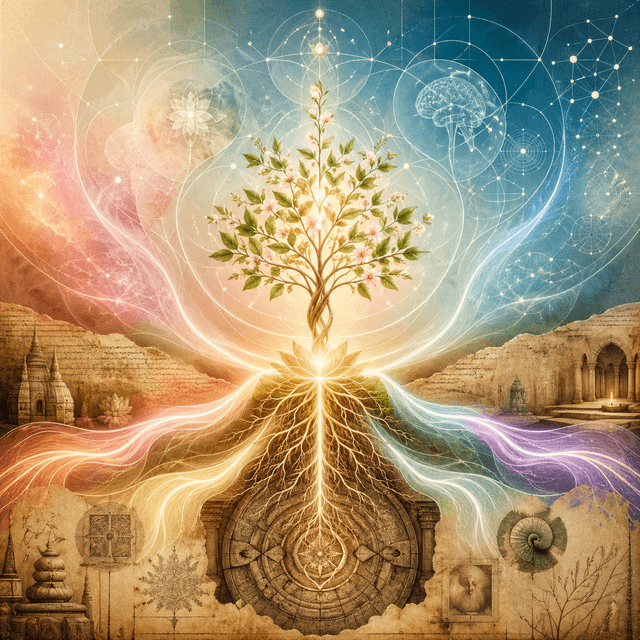
A moral compass refers to an individual’s internalized set of moral values, beliefs, and principles that guide their decisions and actions in ethical or moral situations.
Lesson
Modern positive psychology defines flourishing through Seligman's PERMA model and Carol Ryff's six dimensions, while ancient traditions offer complementary insights. We draw on Christianity's virtues of hope, humility, grace and love, Buddhism's Four Noble Truths and mindfulness, Hinduism's dharma and yoga, Islam's tazkiyah and salah, and Judaism's tikkun olam.

Lesson
In this lesson we cover the simple path to flourishing. Akhil Gupta reveals that human flourishing is not hidden in complexity but in the three core longings of our nature. We draw on Love, Learn, and Play (LLP): the innate triple helix impulses that bring joy to children and unlock authentic self-engagement throughout life.

Lesson
Science, philosophy, and religion are distinct yet complementary paths to meaning. Science describes what is; philosophy explores why through reason; religion speaks to the heart with purpose, awe, and belonging. All three emerge from humanity's fundamental spiritual impulse to understand existence beyond material perception.

Lesson
This is the pressing question that drove Akhil Gupta, former founding chairman of Blackstone India and a highly successful private equity executive, to step away from his corporate life and embark on
Blog
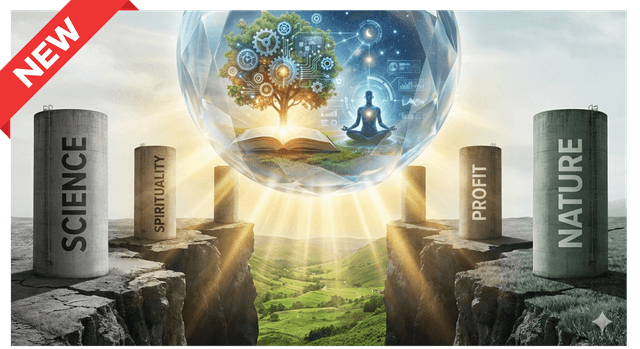
We have become experts in the parts but forgotten how to see the whole. Flourishing requires breaking the false dichotomies between science, spirit, and self.

Blog
Akhil Gupta's personal reading list: 20+ history books that reveal why civilizations rise, fall, and repeat the same mistakes.

Blog
A gardener's experiment proves it: what you speak to yourself shapes what grows. Practical affirmations for morning, midday, and evening.

Lesson
From the Hebrew Bible to the Qur'an to the Bhagavad Gita, traditions converge on a unified message: fear thrives in the small, isolated self, but withers in alignment with the divine. We draw on Isaiah's promise, Jesus' peace, Krishna's call to surrender, Buddhist detachment, and Stoic virtue.

Lesson
We cover UEF's milestone: our bi-weekly Wisdom newsletter reaching over one million readers across 1,000 higher education institutions. We have researched and shared 108 commonalities woven throughout world religions, revealing the universal human quest for meaning and connection.

Blog
The Bhagavad Gita offers timeless guidance for modern spiritual growth through selfless action, inner steadiness, devotion, and disciplined living.

Blog
"Who am I?" Indian philosophy says the answer is not your name or role. Vedanta and the Upanishads reveal: you are already what you seek.

Lesson
In this lesson we cover the sacred number 108 and its place across world religions. We draw on Hindu philosophy's concept of wholeness through the japa mala, Buddhist ritual where 108 temple bells release earthly desires, Jainism's 108 spiritual virtues, and the Qur'an's longer tasbihs used in Sufi dhikr.

Lesson
In this course we cover spirituality as the wellspring of science, philosophy, and religion. All three disciplines spring from humanity's primal impulse to seek meaning beyond sensory perception. We draw on Einstein and Sagan on wonder and awe, Pope John Paul II and Gould on faith and reason, and how meditation, prayer, and mindfulness serve as gateways to deeper reality.

Lesson
The tales of jagat-srishti (cosmic creation) shape the dharmic worldview of various sampradayas, and though these srishti-kathas differ across different mat-panthas, they all describe and define Ishwar as ‘Srishtikarta’ – the divine creator.

Lesson
In this lesson we cover the cosmic tree as universal symbol. This sacred tree connects the heavens and earth, the divine and human, and represents the axis mundi, the center of all existence. We draw on the Hindu Ashvattha, the Christian Tree of Life, Norse Yggdrasil, Celtic World Tree, and Native American symbolism of cedar and pine.
Lesson
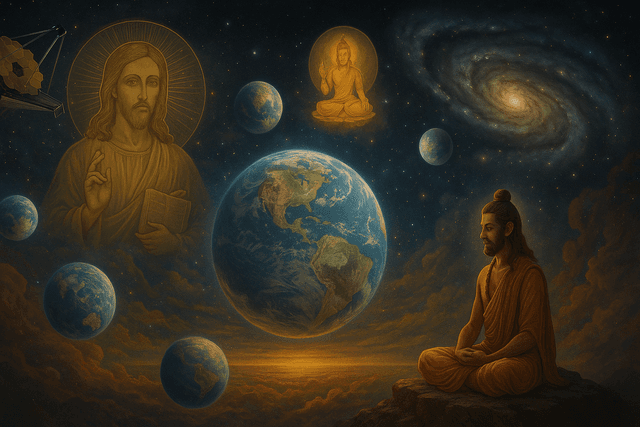
In this lesson we explore whether life extends beyond our visible world. Ancient Indian philosophies have taught the existence of multiple realms for thousands of years: Hinduism's 14 lokas (heavens, earth, and underworlds), Buddhism's six worlds of rebirth, and Jainism's varied planes of existence. Modern science through NASA's James Webb Telescope and multiverse theory now suggests similar possibilities, implying our actions carry consequences across dimensions we cannot yet see.
Lesson
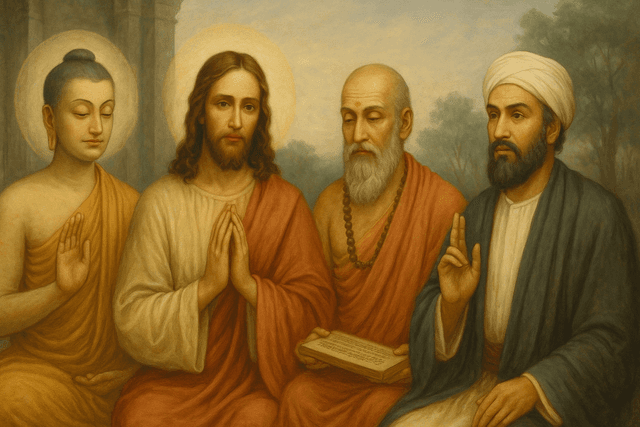
Messengers Of Truth
Lesson
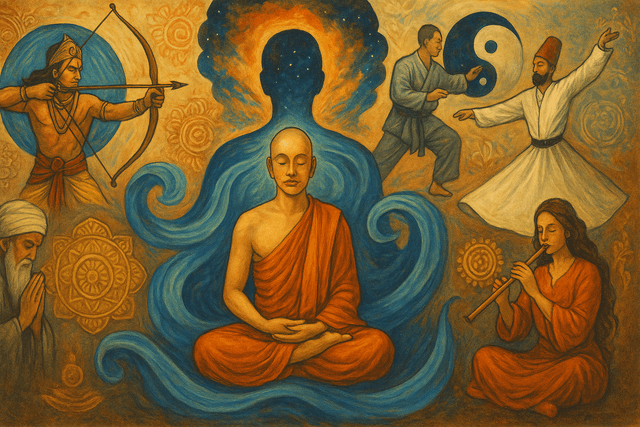
Flow is the optimal state where self-consciousness dissolves and action becomes unified with awareness. Psychologist Mihály Csíkszentmihályi named this modern phenomenon; ancient traditions knew it for millennia. We draw on the Bhagavad Gita's concept of unwavering mind, Buddhism's jhāna states, Taoism's Qi, Islamic Dhikr, and the meditative and movement practices spanning Hinduism, Christianity, and indigenous traditions.

Lesson
In this course we cover how religions split into many sects and paths while sharing one underlying truth. We draw on Christianity's forty thousand denominations, Islam's Sunni, Shia, and Sufi traditions, Hinduism's Vaishnavs, Shaivs, and Shaktas, Buddhism's Theravada, Mahayana, and Vajrayana branches, and the insight that most divisions stem from power and ego rather than fundamental disagreement.

Lesson
This mystical connection represents spiritual achievement where barriers between self and the sacred dissolve. We draw on Hindu Moksha, Buddhist Nirvana, Christian communion with God, Islamic tawhid and Sufi Fana, and Taoist harmony with the Tao.

Lesson
In this lesson we cover flow, the state of complete immersion that bridges modern psychology and ancient contemplative practice. We draw on Mihály Csíkszentmihályi's research, Zen samadhi, Hindu moksha and yoga, Taoist wu-wei, Sufi fana, Christian hesychasm, and indigenous ritual practices that induce transcendent absorption.