
Lesson
Bliss
Joseph Campbell, the popular writer about comparative religion and mythology, once argued that bliss is at the universal core of religion.

Author
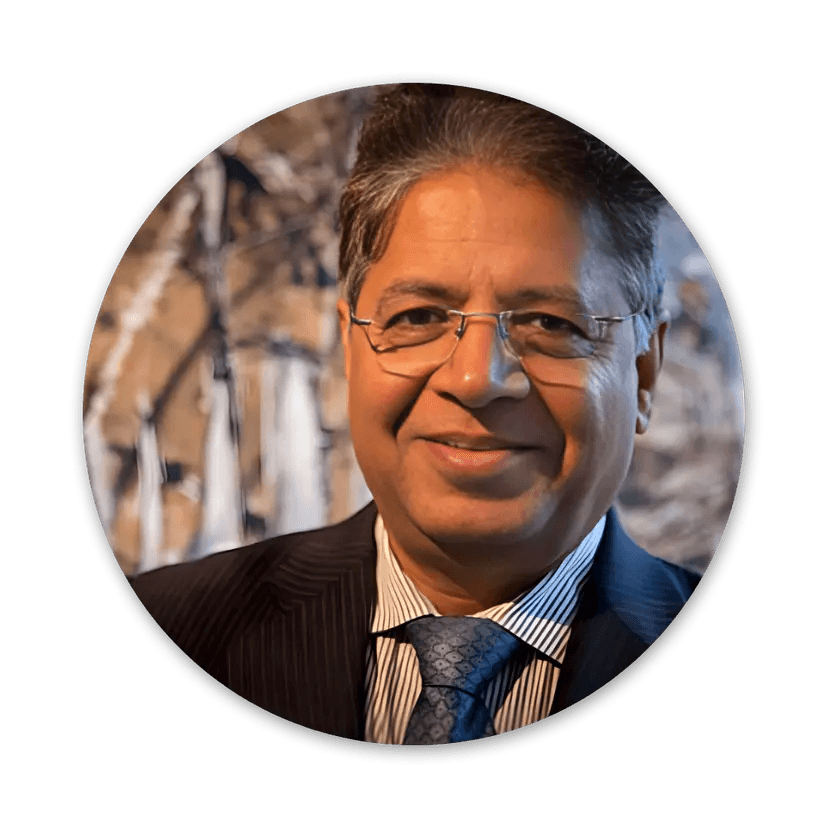
Akhil Gupta is the founder and director of Universal Enlightenment Forum
Akhil Gupta is the founder and director of Universal Enlightenment Forum, a 501(c)3 corporation. He has been associated with Harvard University since 2015, first as a fellow at Advanced Leadership Initiative and later as an Impact Leader in residence in 2023. Akhil currently serves on The Dean’s Leadership Council at Harvard Divinity School, on the Advisory Board of Harvard’s Human Flourishing Program, and on the Advisory Board of Harvard’s Chan Initiative on Health and Homelessness.
He is the author of two books “Bridges Across Humanity” published in 2023 and “To Flourish is To Love Learn Play” published in December 2025.He was inspired to write these books while studying at Harvard University.
Prior to Harvard, he was the founder Chairman of Blackstone India & Senior Managing Director of The Blackstone Group. He also served in senior positions at Reliance Industries Limited and Hindustan Unilever
Akhil has a B.Tech from Indian Institute of Technology and an MBA from Graduate School of Business, Stanford University. He served on the Advisory Council of the Graduate School of Business at Stanford University from 2014 to 2021.
238 pieces
Lesson
Joseph Campbell, the popular writer about comparative religion and mythology, once argued that bliss is at the universal core of religion.

Lesson
Cosmic Tree: The Tree Of Life And Knowledge

Lesson
Circularity is a recurring theme in many religious traditions across the world. It represents the cyclical nature of existence, the interconnectedness of all things, and the eternal return of life.

Lesson
Many traditions believe God governs justice and calls humans to uphold divine law. We draw on the Qur'an's command to justice, the Bhagavad Gita's teaching on dharma and incarnation to restore righteousness, Buddhism's path to cease evil and do good, and karma across Hindu and Buddhist cosmology.

Lesson
In this lesson we cover the two selves: a higher self and a lower self, present across all religious traditions. The goal of human life is transcending the lower self and abiding in the higher self. We draw on Christianity's spiritual body, Judaism's soul, Taoism's balanced mind and body training, Islam's Qur'an, and Hinduism's law of duality.

Lesson
Sibling rivalry is a universal theme across traditions. Jealousy, greed, and pride among family members teach moral lessons about forgiveness and compassion. We draw on Cain and Abel from the Hebrew Bible, the Ramayana's conflict between brothers, and ancient Greek tragedy's exploration of fraternal conflict.

Lesson
Human existence encompasses more than the physical realm. Many world religions acknowledge the presence of non-physical dimensions within human beings, such as the soul, higher consciousness, and spir

Lesson
In this course we cover the teachings of Christ and Krishna. Both figures emphasize love, compassion, and service as pathways to spiritual realization. We draw on Krishna's Bhagavad Gita teaching of selfless action and duty, his relationships with Radha and the Gopis symbolizing divine love, Christ's Sermon on the Mount and emphasis on forgiveness, and their shared call to serve the welfare of others.
Lesson
In this course we cover the striking parallels between Jesus Christ and Krishna. Both are divine incarnations born miraculously, both symbolized as shepherds guiding their flocks, both embodied sacrificial love and rose after death. We draw on the Gospels of Matthew and John, the Bhagavad Gita, the Hindu Mahabharata epic, Father Francis Clooney's comparative theology, and the shared universal archetype of the divine teacher-savior.
Lesson
In this course we cover the parallels between Christian Lent and Hindu teaching. Both traditions offer a 40-day period of spiritual transformation: Christians through fasting and prayer following Jesus' desert ordeal, Hindus through Krishna's teachings to Arjuna on duty and divine wisdom. We draw on the Bhagavad Gita, the Gospels of Matthew and Mark, Father Francis Clooney's comparative theology, and the shared theme of overcoming human limitation through spiritual practice.
Lesson
In this course we explore interfaith dialogue through the work of Father Francis X. Clooney, Jesuit priest and Harvard Divinity professor. His study of Hinduism deepened his Christianity, showing how traditions enrich one another. We draw on his courses on the Bhagavad Gita, the Upanishads, Patanjali Yoga, and the striking parallels between Krishna and Christ.

Lesson
Seeking Union with God Across Traditions

Lesson
In this course we cover diversity as nature's design enabling human flourishing and progress. Eight million species reflect God's creative abundance. We draw on the Quran's celebration of languages and colors as divine signs, Hinduism's infinite adaptability, Ubuntu's principle of shared humanity, and the LLP mindset's expansion of love and learning across all difference.

Lesson
In this course we cover interconnectedness as the foundation of human flourishing. We draw on Vasudhaiva Kutumbakam (the Sanskrit principle that the world is one family), Hindu Upanishadic teachings on seeing all beings as oneself, the Qur'an's emphasis that all humans share a single origin, and systems theory in modern physics and ecology.

Lesson
In this course we cover means and ends inversion, the confusion of goals that marks our age. We examine how institutions and individuals drift from their ultimate ends through false narratives and cognitive bias. We draw on Einstein's wisdom, the LLP framework, and Jungian psychology to recalibrate why we act.

Lesson
In this course we cover living consciously. Awareness of our interconnectedness, beliefs, and cognitive biases frees us from compulsive reactivity. We draw on Buddhist teachings, E.O. Wilson's work on sensory limitation, and the concept of mindfulness as transforming fear into wonder and judgment into compassion.

Lesson
In this course we cover the meaning of human flourishing across three realms: physical, internal, and intersubjective. We examine humanity's progress in science and governance, the paradox of material abundance amid mental suffering, and the call for a new enlightenment grounded in our inner and collective worlds.

Lesson
We explore how diverse religions reveal shared human longings for meaning, purpose, and connection to something beyond ourselves. Francis Clooney's insight that religion flourishes in the particular but reveals universal principles guides ten key takeaways: respect diversity, believe in interconnectedness, extend compassion universally, reject interpretations that divide, be truth-seekers, read scriptures allegorically.

Lesson
In this course we cover love as the antidote to hate. In times of division and conflict, love offers a pathway toward healing and reconciliation. We draw on the work of Dr. Tyler VanderWeele and the Harvard Human Flourishing Program's research on love's transformative power.

Lesson
In this course we cover Thanksgiving. This harvest festival celebrates gratitude, abundance, and the bonds of community. We draw on Henry van Dyke's reflection on thankfulness, Maya Angelou's wisdom on gratitude as spiritual foundation, the Indigenous traditions of harvest celebration, and the universal practice of recognizing providence and blessing in our lives.

Lesson
In this course we cover how love, learning, and play dismantle racism and build human unity rooted in our shared nature. We draw on Jesus's parable of the Good Samaritan, Gandhi and Martin Luther King Jr.'s vision of justice as love in action, Buddhist teachings on overcoming hatred through love, Sufi teachings on Quranic passages denouncing violence, Hindu Lila and the diversity of life, and Du Bois's affirmation of one human race.

Lesson
In this lesson we cover metaphor in scripture. Religious texts use metaphor to convey complex ideas through familiar imagery. We draw on Maimonides' allegorical reading, the Hindu Upanishads, symbols of clay and lotus found across Christianity, Islam, Judaism, Buddhism, and Baha'i teachings on how veils and clouds represent ignorance.

Lesson
In this course we cover unity across religions. The world's wisdom traditions reflect different cultural expressions of shared human meaning-making. We draw on Swami Ramakrishna's recognition of one God through many paths, the Rig Veda's Ekam sat vipra bahuda vadanti, interfaith dialogue practices, and the elephant and blind men parable.

Lesson
In this course we cover three essential practices for everlasting happiness. Akhil Gupta shows that like flowers requiring sun, water, and air, humans flourish through Love, Learn, and Play (LLP). When we engage these three pursuits consciously in all daily activities, we transcend false narratives about success and discover authentic fulfillment.