
Living in the
foothills of the singularity.
If intelligence becomes abundant,
what will we live for?

Much of a life can be spent acquiring the means: an education, a career, money, recognition. AI invites us to imagine new routes to knowledge and creation. What will we want those possibilities to serve?
The foothills are a place to look ahead—and to take stock of the purposes, stories, and habits we bring with us. In Love, Learn, Play, Akhil Gupta offers a way to examine them.
“Ten years from now, I think we’ll realize that we were standing in the foothills of the singularity now.”
Stanford GSB, June 18, 2026
When the means change,
revisit the ends.
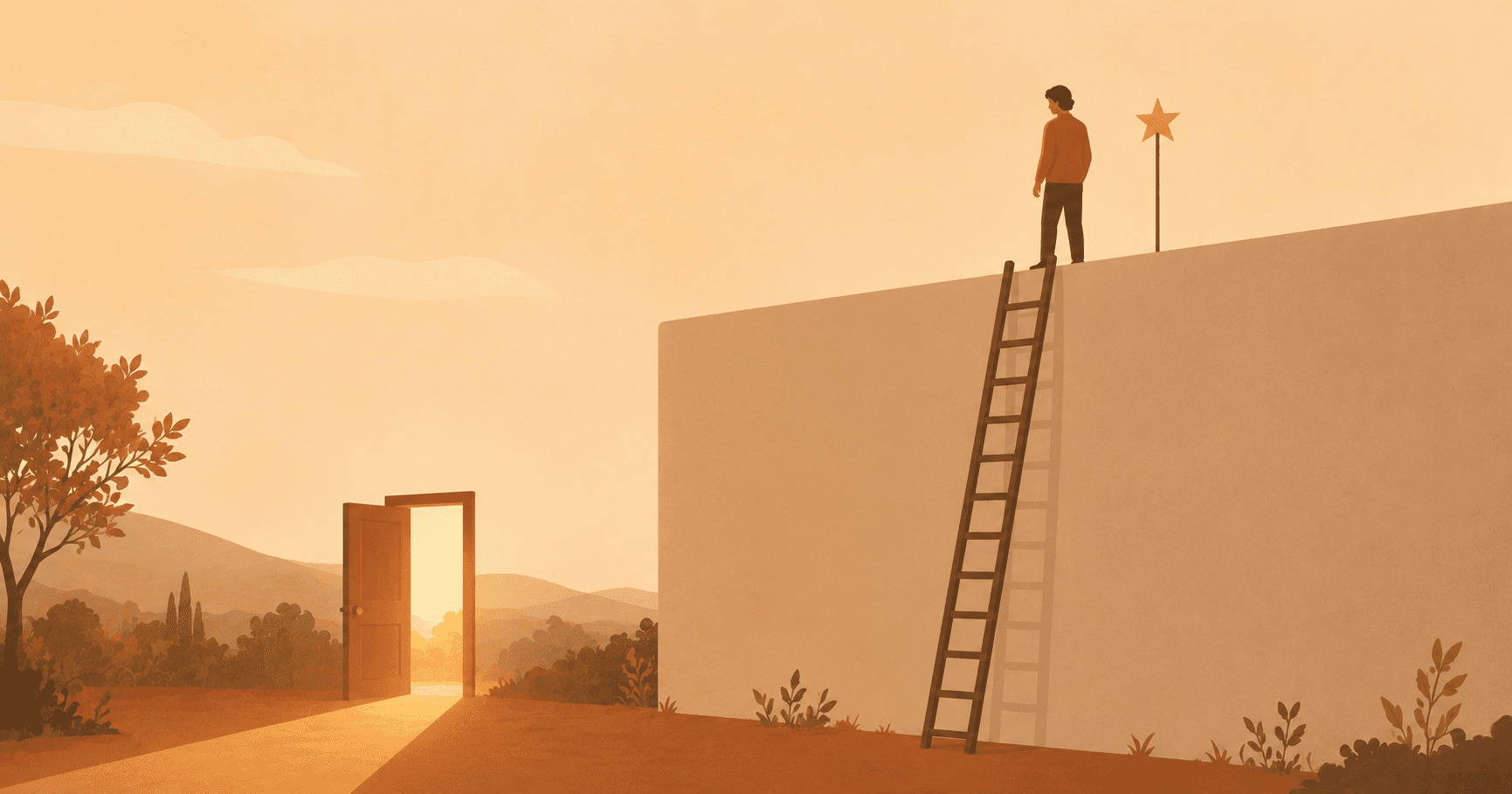
Suppose AI could help you accomplish an ambition that once seemed out of reach. Would you still choose it? Perhaps yes—with new energy and room to go further. Or perhaps its appeal rested on the recognition of doing what few others could.
Gupta describes how a pursuit can gradually displace the life it was meant to support. Greater capability gives us a reason to examine both the possibilities opening to us and the purposes we bring to them.
The invitation is to become more conscious of our ambition: what we would love to do, what we hope it will make possible, and when the pursuit itself is fulfilling.
We all have an innate need to be loved, respected, and accepted by others. We start learning by imitating others whom we hold in high regard. We conform to societal norms. During our cognitive development process, we start overlaying a social self on top of our authentic self. In the process, we assimilate many false metanarratives that focus on means and not our ends. We start to measure the means and start to define our goals to maximize the means. Gradually, the means crowd out our ends. As we start to feed this socialized self, we increasingly start to starve our authentic self, which inherently longs for love, learning, and play. We succumb to what is known as “means/ends inversion,” (MEI), mistaking the means to a good life for the ends.
Chapter 1 · Why Happiness Eludes Us, pp. 27–28
What are we carrying into the future?

Our stories about what makes us valuable.
I am my job. My value depends on what I can do better than others. Learning only counts if it pays. These are beliefs we can examine. A changing world can make their influence easier to see.
AI may challenge a familiar sense of competence; it may also reveal abilities we thought were beyond us. We can question the limits we have inherited and the standards by which we judge ourselves.
The same inquiry applies to stories about the future. Which parts have evidence behind them? Which are hopes, assumptions, or possibilities that our choices could still influence?
Our habits of attention and participation.
The world may change faster than our habits expect. We can be curious about what lies ahead while attending to the choices already available: what we build, how we learn together, whose perspectives we seek, and how we treat the people around us.
AI can be a partner in that inquiry—helping us approach unfamiliar ideas, question an assumption, imagine alternatives, and give an intention a form we can act on.
For Gupta, conscious living reaches beyond awareness of ourselves. It includes the effort to understand other lives. As our capabilities grow, how might that circle of care grow with them?
What would a flourishing life look like?
Love, learning, and play are Gupta’s proposed ends of a good life. Explore what each could mean as our possibilities expand.
Love: Let our circle of care grow with our capabilities.
Let our circle of care grow with our capabilities.
Greater capability can enlarge the circle of people we can understand and help. We can ask what we would build for someone else, whose needs we could come to understand, and how the benefits of new intelligence might be shared.
If you could help more, who would you want to help—and how would you learn what matters to them?
Begin the reflectionFurthermore, conscious living encourages us to extend our awareness beyond ourselves and to cultivate empathy for others. It requires actively listening, not just to the words spoken but also to the unspoken emotions and experiences that lie beneath.
Continue the passageClose the passage
This involves challenging our assumptions and recognizing that everyone is on their own unique journey, brought up in their unique narratives, facing their own unique set of challenges. By consciously choosing to see the world through the eyes of another, we begin to break down the barriers of separation and cultivate genuine connection.
Chapter 3 · The Shift to Living Consciously, pp. 91–92

How are you living in the foothills?
Consider your ambitions, your sense of worth, and the future you imagine. Check a statement you recognize; each opens a question to explore.
Stay with one question that matters to you. As new possibilities open, what would you choose to deepen—for yourself or someone else?
Prompts adapted from Akhil Gupta’s Love, Learn, Play.
What if we learned to harness love?
“The day will come when, after harnessing the ether, the winds, the tides, gravitation, we shall harness for God the energies of Love. And, on that day, for the second time in the history of the world, man will have discovered fire.”
Hassabis invites us to imagine a transformation in intelligence. Teilhard invites us to imagine a transformation through love. UEF brings these possibilities into conversation: as we become capable of more, what kind of life—and what kind of world—will we choose to cultivate?